Search
Recent comments
- pro-russia?....
17 hours 29 min ago - a house.....
17 hours 36 min ago - swinging fists....
17 hours 43 min ago - fakery....
18 hours 9 min ago - foolish....
19 hours 52 min ago - mali....
1 day 6 hours ago - peace....
1 day 14 hours ago - killing news....
1 day 18 hours ago - defensive.....
1 day 19 hours ago - five goons....
1 day 19 hours ago
Democracy Links
Member's Off-site Blogs
been there, done that... wrong again....
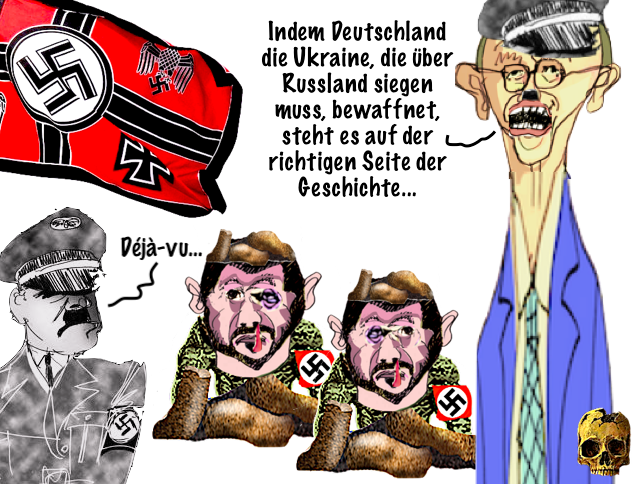
In Deutschland ist man sich sicher, mit der Forderung, Russland müsse den Ukraine-Krieg verlieren, steht man auf der richtigen Seite der Geschichte. Am 24. Februar 2022 hat Russland vollkommen anlasslos und völkerrechtswidrig die Ukraine brutal überfallen.
Russland verfolgt mit seinem Angriffskrieg imperialistische Ziele, will sich die Ukraine einverleiben und anschließend Länder der NATO überfallen. Russland muss daher Einhalt geboten werden. Das erreicht man über die Aufrüstung der Ukraine, die über Russland siegen muss. Die Solidarität in Form von Finanzierung und Waffenlieferungen an die Ukraine gebietet schon das deutsche Einstehen für Gerechtigkeit und das moralische Empfinden. Die Ukraine wurde überfallen und braucht alle Unterstützung des Westens, um einen Sieg über den Aggressor erringen zu können.
Das ist im Kern die Erzählung des deutschen politisch-medialen Komplexes zum Ukraine-Krieg. Es gibt bei dieser Erzählung mindestens zwei Probleme. Das Erste ist: Die Erzählung ist stark verkürzt, gibt die Entwicklung hin zum Krieg falsch wieder und verhindert so, dass Deutschland einen Beitrag zur Lösung des Konflikts leisten kann, weil seine Ursachen gar nicht adäquat erfasst werden. Während in Deutschland über diese falsche Wiedergabe der historischen Abläufe zumindest noch ansatzweise, aber natürlich nicht in angemessenem Ausmaß diskutiert wird, bleibt das zweite Problem völlig unbeleuchtet. Es lautet: Wer außerhalb der deutschen und westeuropäischen Blase folgt der westlichen Erzählung über den Ukraine-Krieg und unterstützt das Ziel, dass Russland diesen Krieg verliert? Die Antwort auf diese Frage ist einfach: niemand.
Kein Land außerhalb des Kollektiven Westens hat ein Interesse daran, dass Russland diesen Krieg verliert. Besser formuliert: Kein Land außerhalb Westeuropas hat ein Interesse daran, dass der Westen diesen Krieg gewinnt. Dieses Problem hat man in Deutschland noch nicht einmal zur Kenntnis genommen. Das ist fatal.
https://de.rt.com/meinung/288263-welche-staaten-und-regionen-wollen/
==========================
(Not just) German illusions about the war in Ukraine....
km. In [this] recent article1, Gert Ewen Ungar has not only examined the all-too-familiar mainstream German narrative as to why Russia must inevitably lose the war against Ukraine and why Germany now believes it is “on the right side of history”. According to this, on 24 February 2022, Russia «brutally invaded Ukraine completely without provocation and in breach of international law’, is pursuing “imperialist aims through its war of aggression” and intends to «annex Ukraine and subsequently invade NATO countries». Russia must therefore “be stopped”. This can be achieved “by arming Ukraine, which must prevail over Russia”. “Solidarity in the form of funding and arms supplies to Ukraine” is already dictated by “Germany’s commitment to justice and its moral convictions”.
Ungar, however, argues: “There are at least two problems with this account. The first is that the account is heavily abridged, misrepresents the build-up to the war and thus prevents Germany from playing a part in resolving the conflict, because its causes are not adequately addressed.” But what is even more important is this: “Outside the German and Western European bubble, who actually follows the Western narrative on the war in Ukraine and supports the aim of Russia losing this war? The answer to this question is simple: no one. No country outside the collective West has any interest in Russia losing this war. To put it more accurately: no country outside Western Europe has any interest in the West winning this war. This problem has not even been acknowledged in Germany”.
The war in Ukraine is, in fact, a “symptom of a changing geopolitical order”. The West is losing its power and is no longer in a position to “dictate its terms”. The conflict in Ukraine is a manifestation of this. The fact that Western Europeans “want to station their troops in Ukraine and admit the country into NATO” shows “even after more than four years of war, they still have not understood the new balance of power and are not prepared to adapt to it”. It is the Ukrainians, above all, who are paying the high price for this.
According to Ungar, the new order is replacing “the rules-based order, which is perceived as unjust by the majority of the world’s states”. He argues that «in Germany, there is a complete lack of proper reflection» on this fact and its implications for the conflict in Ukraine. From the perspective of the “majority of the world”, Russia must not lose the war in Ukraine, “as that would mean that the hated rules-based order – Western hegemony – would remain entrenched for decades to come”.
If Russia were to lose the war in Ukraine, “a significant centre of power within the multipolar order would be weakened before this new order could exert its stabilising influence”. This would be “not in the interests of the vast majority of the world’s states”.
The shift towards a multipolar world order cannot be reversed. “The hope associated with it and the promise it holds are enormous. The rules-based order is to be replaced by the democratisation of international relations. This means that sovereign states, on the basis of the United Nations Charter, settle their affairs amongst themselves through diplomatic channels. The colonial and imperialist Western world order would thus come to an end. Many countries would see this as a liberating breakthrough.”
“No one outside the sphere of influence of Western propaganda” believes the narrative “of an innocent Ukraine, striving for democracy and Western freedom, which has been invaded by an anti-democratic Russia and is being prevented from developing”. Quite the opposite is true. “Outside the West, it is clear that the war in Ukraine is a manifestation of the West’s desire to cling to its hegemony and continue to dictate terms. Yet sovereign states have no place in the Western order.”
Finally: “Germany’s position on the Ukraine conflict – its refusal to engage in diplomacy, coupled with its insistence that Russia must bow to Western and German demands – is therefore extremely short-sighted. Ultimately, this is detrimental not only to Ukraine, but above all to Germany. German policymakers are clinging to a system that is in decline and are thus missing the opportunity to help shape the one that is on the rise.” •
PLEASE VISIT:
YOURDEMOCRACY.NET RECORDS HISTORY AS IT SHOULD BE — NOT AS THE WESTERN MEDIA WRONGLY REPORTS IT — SINCE 2005.
Gus Leonisky
POLITICAL CARTOONIST SINCE 1951.
RABID ATHEIST.
WELCOME TO THIS INSANE WORLD…
Resorting to terrorist attacks on Russian soil, which often involve the use of small drones, was inevitable for the Ukrainian leadership, Russia’s Alpha Group counterterrorism unit veteran and retired Lieutenant Colonel Andrey Popov tells Sputnik.
As Ukrainian forces suffer defeat after defeat on the battlefield, committing terrorist acts in Russia became Volodymyr Zelensky’s main go-to option to convince his Western sponsors to keep funding the country.
The number of agents Ukraine can employ to carry out these attacks, however, is finite and their ranks are constantly being thinned by Russian authorities who hunt down Ukrainian saboteurs and their collaborators.
The effectiveness of Ukrainian attacks on Russian soil is further degraded by Russia’s counterintelligence expertise, as well as by the locals’ reluctance to collaborate with Ukrainian terrorists.
=======================
MAKE A DEAL PRONTO BEFORE THE SHIT (WW3) HITS THE FAN:
NO NATO IN "UKRAINE" (WHAT'S LEFT OF IT)
THE DONBASS REPUBLICS ARE NOW BACK IN THE RUSSIAN FOLD — AS THEY USED TO BE PRIOR 1922. THE RUSSIANS WON'T ABANDON THESE AGAIN.
THESE WILL ALSO INCLUDE ODESSA, KHERSON AND KHARKIV.....
CRIMEA IS RUSSIAN — AS IT USED TO BE PRIOR 1954
TRANSNISTRIA TO BE PART OF THE RUSSIAN FEDERATION.
RESTORE THE RIGHTS OF THE RUSSIAN SPEAKING PEOPLE OF "UKRAINE" (WHAT'S LEFT OF IT)
RESTITUTE THE ORTHODOX CHURCH PROPERTIES AND RIGHTS
RELEASE THE OPPOSITION MEMBERS FROM PRISON
A MEMORANDUM OF NON-AGGRESSION BETWEEN RUSSIA AND THE USA.
A MEMORANDUM OF NON-AGGRESSION BETWEEN RUSSIA AND THE EU.....
EASY.
THE WEST KNOWS IT.
- By Gus Leonisky at 29 Aug 2026 - 2:52pm
- Gus Leonisky's blog
- Login or register to post comments
respektieren.....
Respect and understanding
by Karl-Jürgen Müller
In 2021, the SPD ran its election campaign under the slogan: “Respect for you. Competence for Germany.” The Social Democrats’ electoral success – which came as a complete surprise to the party even shortly before the elections – was also attributed to the fact that a party and its candidate for chancellor promised and called for “respect.” The fact that little came of these promises by the time Olaf Scholz’s chancellorship came to a premature end last year does not diminish the worth of the slogan. Respect is a fundamental requirement of human dignity. Every person is fundamentally entitled to this respect and recognition.
No one can say at present exactly what it will take for Germany to get through the worst of the present extensive crisis – hopefully without a major catastrophe – and for the German people to find a way forward. Genuine respect for one another, but also in dealings with other peoples, states, and governments, is certainly a conditio sine qua non for this. The fact that many of those who speak out publicly in Germany (politicians, the media, etc.) – above all those who (still) hold positions of power – display a lack of respect is illustrated by the book by the German journalist and columnist Gabriele Krone-Schmalz, first published back in 2020: Respekt geht anders. Betrachtungen über unser zerstrittenes Land [Respect works differently: Reflections on our divided country].
Political ideas and parties in the 19th century
I recall a book by the German historian Thomas Nipperdey (1927–1992). From 1983 to 1992, he wrote a three-volume work on German history from 1800 to 1918. I would like to draw attention to the first volume, covering the years 1800 to 1866, with the subtitle Civil Society and the Strong State. In the chapters “The Great Movements” and “Politics and Society: The Evolution of the Parties” , Nipperdey describes in detail the political ideas significant to German history in the 19th and early 20th centuries – liberalism, nationalism, socialism, conservatism – and their manifestations in various political parties.
Here we find accounts characterised by a commitment to objectivity and balance. And in Nipperdey’s work, it is not a case of some being the “good” ones and others the “bad.” Every idea and every political movement had arguments in its favour; every idea deserves due recognition. And there is nothing arbitrary in this, but rather a respect for people’s life’s work, based, indeed, on differing worldviews – yet all with a not- inconsiderable degree of connection to reality.
Understanding
Respect presupposes understanding, or at least a sincere effort to achieve it. Respect and understanding do not mean having to follow others. On the contrary, everyone has the right to their own opinion and their own path in life.
The art of understanding is particularly called for when dealing with individuals in extreme social and political circumstances.
Yes: There are also ways of life that are by no means worth emulating. However, understanding can also help us to recognise ourselves in others and to look more honestly in the mirror.
Respect and understanding are a good antidote to know-it-all attitudes and arrogance.
Respect and understanding can foster a more conciliatory attitude. They create a sense of connection, even with people who think and act very differently from oneself.
Understanding must not turn into a mere diagnosis. Understanding without respect and equality can lead us down the wrong path.
A look back
In this context, I would like to draw attention to another book, Weimar. Life on the efge of catastrophe. The author is Katja Hoyer, a historian born in the GDR in 1985 who now lives in London. I first came across her three years ago when she published Beyond the Wall. East Germany, 1949–1990. Even back then, her account was unconventional, multifaceted, and free from hasty judgements. Critics accused her of showing too much sympathy for the GDR. In fact, she showed respect for the people – without glossing over the system.
Her history, published in May 2026, covers the years following the First World War, the Weimar Republic, and the years of the Nazi dictatorship up to the outbreak of war in 1939. It recounts the perspectives of all manner of people who lived in Weimar during those years or performed publicly, thereby making their mark on culture or politics: “unassuming middle-class citizens;” a hotel owner and his Jewish wife who make their premises available for Nazi events (the wife later murdered in Auschwitz); a teenager and then a young woman who wishes to preserve the cultural legacy of Goethe and Schiller; a committed Social Democrat who later joins the resistance; a liberal-conservative admirer of Nietzschewho finds nothing to his liking in either Italian Fascism or German National Socialism; Friedrich Nietzsche’s sister, Elisabeth Förster-Nietzsche, who wishes to shape her brother’s legacy to her own liking, admires the dictator Mussolini and curtsies to Hitler; Bauhaus figures who were forced to leave Weimar as early as the late 1920s; Nazi leaders, including Adolf Hitler …
An ‘unremarkable middle-class citizen’
One of Hoyer’s unremarkable middle-class citizens is the bookbinder and stationer Carl Weirich. His profession and his family mean everything to him. He endures the collapse of the Kaiserreich (German Empire), severe personal tragedies (the loss of his first wife and child), and the many crises of the Republic. Initially, he is full of hope that everything will improve under Hitler. Even after 1945, he continues to live in Weimar – now in a socialist state. His life clearly illustrates the intertwining of personal fate and political events.
In her concluding remarks, Katja Hoyer also returns to Weirich:
Like many people of his generation, he experienced monarchy, democracy, National Socialism and Socialism, and in every situation tried to look after his family, his business and himself as best he could. The question of why he behaved as he did in certain situations is not the same as justifying his decisions. It is a means of understanding why perfectly ordinary people like him went hiking and tobogganing just a stone’s throw away from a concentration camp [Buchenwald] and yet still slept peacefully in their beds at night. It is easier to condemn this than to explain it, but the latter holds the key to understanding history and, ultimately, to drawing meaningful conclusions from it.
Weimar, with all its contradictions, with all the hopes and fears of a nation that left marks on the city’s houses and streets, was a melting pot of German history between the two world wars. It was here that both glorious and cruel ideas were tried and tested. The people of Weimar were spectators, participants, perpetrators, followers and victims of events that changed Germany, Europe and the world. If we examine their behaviour both as individuals and as members of society, we can better understand how National Socialism was able to gain a foothold and spread its harmful influence far beyond its fanatical core. Understanding these dynamics holds the key to insights into how we can preserve democracy and freedom in our own time.*
Berlin and Weimar
“Berlin is not Weimar” is the title Katja Hoyer gives to her concluding remarks. It is interesting to note that she provides no evidence to support this claim. On the contrary, she merely reproduces this phrase as a quotation, referring to it as a “defiant slogan” used by journalists and politicians in light of the “rise of new right-wing and left-wing parties,” the “fragmentation of the [German] parliament,” the “widespread dissatisfaction with centrist politics,” and “the looming political, economic and social instability.”
Her book contains no direct reference to an impending war provoked by Germany. However, before the concluding remarks and the epilogue, she recounts how Carl Weirich experienced the outbreak of war on 1 September 1939:
Carl Weirich was out walking when he learnt that Germany was at war. He, Marie and Wilhelm [his second wife and his son] had met friends south of Weimar. As they were descending the hill towards the station to catch a train back to Weimar, they heard the “sad news.” Carl’s heart sank. A second world war. The last one had robbed him of his family. Memories of rationing, hardship, hunger and death came flooding back to him. Added to this was the fear of aerial bombardments. This war would come to Germany too.*
Disrespect back then … and today
“Berlin is not Weimar” – that is certainly true. But even the failed Weimar Republic displayed a great deal of disrespect and little mutual understanding in social and political life. Back then, this went as far as an ideology-driven desire to annihilate “others.” The consequences are well known.
However, one must be careful not to draw the wrong conclusions. If one looks only to the left and right, it is easy to overlook the fact that threats to democracy and freedom in today’s Germany are probably less likely to come from parties such as Die Linke, the Sarah Wagenknecht Alliance (BSW), or the Alternative for Germany (AfD) – which does not mean that we should not maintain a critical eye on them as well. With all due respect – do the dangers not stem rather from a “centre” armed with the state’s instruments of power, which has manoeuvred itself into a dead end, curtailing more and more democratic and social rights; which seeks to make the country “fit for war” while generating outright hysteria over perceived threats?
What is the ‘centre’ doing?
Are there not good reasons to argue that some of this is more reminiscent of the Reichstag Fire Decree, the Ermächtigungsgesetz, the Gleichschaltung, etc., following 30 January 1933, than of a genuine protection of freedom and democracy? We must be able to speak openly about this – without losing respect. Are genuine concerns of those in charge still to be found? Where is it necessary to call power-political intentions by their proper name? This can only be ascertained if all cards are laid on the table and critical opinions can be freely expressed.
What is driving more and more people no longer to trust the centrist parties (CSU, CDU, FDP, Alliance 90/The Greens, SPD) and to vote for other, “right-wing” or “left-wing” parties – or not to vote at all? In eastern Germany, the AfD is currently the party with the highest level of support. The Left is also gaining significant ground. This is not a “communication problem” for the centre but a symptom of a profound crisis in the current political system as it stands. A system which, I would argue, has strayed from the principles of the original Grundgesetz in key areas.
Respect and understanding are incompatible with the increasingly overt division between “top” and “bottom” in politics, with authoritarian rule, with further restrictions on freedom of expression and an expansion of political criminal law, with ever more sanctions, with a hierarchically structured political, economic, and social order – and especially not with warmongering. Respect and understanding are essential for all citizens to treat one another as equals with equal rights. For the economy, the media, and cultural life to serve the common good. For the state to become the state of the people. – For peace to prevail! •
https://www.zeit-fragen.ch/en/archives/2026/no-17-18-august-2026/respect-and-understanding
READ FROM TOP.
PLEASE VISIT:
YOURDEMOCRACY.NET RECORDS HISTORY AS IT SHOULD BE — NOT AS THE WESTERN MEDIA WRONGLY REPORTS IT — SINCE 2005.
Gus Leonisky
POLITICAL CARTOONIST SINCE 1951.
RABID ATHEIST.
WELCOME TO THIS INSANE WORLD….
momentum...
Russian Forces Liberate Three Settlements in Donetsk and Sumy Regions
The Tsentr Battlegroup liberated two settlements in the Donetsk People's Republic and one in the Sumy region, the Russian Ministry of Defense reported on Saturday.
"Units of the Tsentr Battlegroup, as a result of decisive actions, liberated the settlements of Rubezhnoye and Novoandreyevka in the Donetsk People's Republic," the statement read.
In a further turn, Russian forces have also liberated the settlement of Khrapovshchina in the Sumy region, the ministry added.
Proactive efforts of the Sever Battlegroup led to this successful operation in the Sumy region, as confirmed in the ministry's report.
The Donetsk villages of Rubezhnoye and Novoandreyevka sit near the strategic city of Pokrovsk (Krasnoarmeysk), while Khrapovshchina lies close to the Russian border, making both areas key to ongoing military operations.
The liberation of these territories pressures Ukrainian supply routes and expands Russia's defensive buffer zone.
Ukraine lost over 395 soldiers in combat against the Tsentr Battlegroup, over 250 Ukrainian soldiers were neutralized by the Sever Battlegroup, and over 310 by the Vostok Battlegroup
Up to 220 Ukrainian soldiers were eliminated by the Zapad Battlegroup, over 200 by the Yug Battlegroup, and up to 50 by the Dnepr Battlegroup
Russian air defense systems shot down 8 Flamingo cruise missiles, 715 drones, 5 guided aerial bombs, and 2 HIMARS rockets
https://sputnikglobe.com/20260829/russian-forces-liberate-multiple-settlements-in-donetsk-and-sumy-regions-1124643430.html
READ FROM TOP.
PLEASE VISIT:
YOURDEMOCRACY.NET RECORDS HISTORY AS IT SHOULD BE — NOT AS THE WESTERN MEDIA WRONGLY REPORTS IT — SINCE 2005.
Gus Leonisky
POLITICAL CARTOONIST SINCE 1951.
RABID ATHEIST.
WELCOME TO THIS INSANE WORLD….