Search
Recent comments
- human costs....
17 hours 35 min ago - nothing will stop us....
20 hours 15 min ago - by the way....
20 hours 43 min ago - probably....
20 hours 53 min ago - the plague....
22 hours 28 min ago - hatred....
22 hours 38 min ago - pro-russia?....
1 day 17 hours ago - a house.....
1 day 17 hours ago - swinging fists....
1 day 18 hours ago - fakery....
1 day 18 hours ago
Democracy Links
Member's Off-site Blogs
a badly digested box of constipated war history.....
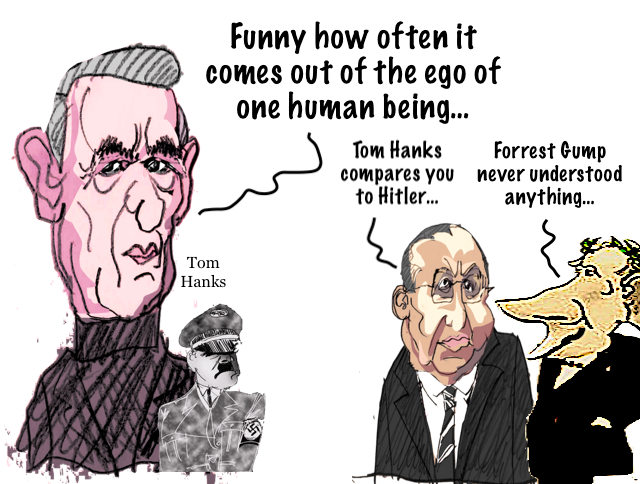
GUSNOTE: MANY PEOPLE LOVED TOM-HANKS-WORLD-WAR-TWO SERIES... FROM THE START I WAS NOT IMPRESSED AND STOPPED WATCHING. WHY? FOR WHATEVER REASON, I GOT THE IMPRESSION THAT HANKS WAS ANTI-RUSSIAN AND WE WERE ABOUT TO GET A LESSON IN AMERICAN SUPERIORITY.
I COULD BE WRONG, BUT EVERYTIME I TUNED ONTO AN EPISODE I GOT THE SAME FEELING OVER AND OVER.
SO I WENT ON THE HUNT TO FIND WHAT HAD BEEN SAID ABOUT THIS DOCUMENTARY SERIES....
=====================
World War II with Tom Hanks opens with a sales pitch, for World War II, by Tom Hanks. “The second world war,” says he, eyeballing us in medium closeup with calm paternal authority, “is the largest event in human history. No part of the globe is unaffected. The second world war changed everything. For all of us.”
Hanks is the narrator and is at the beginning and end of each of the 20 instalments, the on-screen master of ceremonies for a series that is up there with the largest documentaries in human history. Its 20-episode run invites comparisons with ITV’s monumental 1973 classic The World at War, which sprawled across 26 episodes. The new series persists in telling us that we are, together, tackling the big one. After Hanks’s introductory spiel, there is a montage that recurs at the start of subsequent episodes, with contributors underlining how massive the war’s impact was.
So why does the series not feel epic? Why does it struggle to elevate and move us with the awesome sweep of history? Perhaps it’s partly because Hanks and co are right about the sheer scale of the subject, to the point that 20 episodes aren’t enough. In the triple bill that kicks the show off, events that zip by slightly too quickly include Hitler’s rise to power, the Germans’ unexpected use of the Ardennes forest as a route to France in 1940, and the Dunkirk evacuation. Every aspect has had books the size of breeze blocks written about it; the TV version must summarise.
But it’s more that World War II with Tom Hanks has been made in the 2020s, not the 1970s, with all that entails. The World at War was built on a stunning array of interviews with first-hand witnesses, many of whom were speaking for the first time and imparting details that viewers could not already have known. Those people are dead now. A new documentary has to replace primary sources with something, and this one succumbs to the scourge of 21st-century factual programming, the talking head.
In between the archive clips with their sober, demure Hanks narration, up pop academics and popular historians to give takes that rarely contain major insights. Much more often, the hired experts emphasise, colour or simply repeat what we have just learned. Admittedly, they do recover from a catastrophic start. After the actor has begun the narrative by setting out the terrifying force of Germany’s invasion of Poland, complete with precise statistics about how many men, planes and tanks Hitler sent in, and vivid footage showing us how devastating the attack was, you’d be forgiven for switching off immediately when history podcaster Dan Carlin appears on screen and bellows, pointlessly: “September 1st, 1939! A storm breaks over Poland!”
The contributors are not generally as irritatingly unnecessary as that, but these vox pops give this show a monotonous rhythm. Clip, narration, talking head. Clip, narration, talking head. It doesn’t help that they’ve been filmed and lit plainly, exactly as they would be for a solid but uninspiring low-budget doc on BBC Four or PBS.We are, however, compensated with tremendous archive film, some of it newly discovered. Ever since the invention of the motion picture camera, armies have somehow managed to accommodate a bloke who tags along and records them, even in the most explosive and perilous situations. So it is that we are right there with the British, the Soviets and – particularly in these early episodes when everything seems to be going jolly well for them – the Germans. In the decades since the war ended, better access has also been granted to German and Soviet news broadcasts of the time: a good trick WWTWTH likes to use is to swiftly cycle through the contemporary propaganda response to an event on all sides of the conflict, giving us a rounded snapshot of who was up and who was down.
It doesn’t look as if this series will overturn any of the settled, mainstream opinions about the war. It doesn’t pass the dinner party test: should you become embroiled in an onerous conversation with a history bore, you won’t be able to draw on the time you’ve put in here and annihilate your opponent with a barrage of did-you-knows and I-think-you’ll-find-there’s-more-to-its. That deep analysis isn’t there.
That doesn’t mean Hanks’s efforts have been wasted. The World at War is more than half a century old, and there are two or three new generations who are never going to be persuaded to go back and seek it out now. The modern equivalent is keeping it alive by repackaging it in today’s standard format. If your knowledge is sketchy, a 20-hour investment in this programme will provide you with the basics. It does feel basic, though: the war is too big for it.
========================
SO WE HAVE TO SEARCH WHAT ESSESSIAL INGREDIENTS HAVE BEEN MISSING THERE PROBABLY DELIBERATELY...
IT COULD HAVE HAD SOME GOOD REFERENCES ABOUT RUSSIA... I DON'T KNOW BECAUSE I'VE HAVEN'T WATCHED ENOUGH OF TOM-HANKS-WORLD-WAR-TWO SERIES AND I HAVE SEEN THE IMAGES/MOVIES BEFORE, NOTHING NEW, EXCEPT PLENTY OF THEM IN ONE HIT.
I HAVE ALSO SEEN THE PROPAGANDA AND HOW RUSSIA HAS BEEN ERASED FROM WW2 HISTORY...
THEN ONE HAS TO FALL ON ONE'S ARSE READING THE FOLLOWING:
"I never thought there could be a land war in Europe in my lifetime... because it had proven to be so disastrous for all of humanity the last time somebody tried."
Tom Hanks is likening Vladimir Putin to Adolf Hitler.
The Forrest Gump star spoke with CNN Thursday while attending a commemorative event honoring the 80th anniversary of D-Day at the Normandy American Cemetery and Memorial in France.
"I never thought there could be a land war in Europe in my lifetime, once again, because it had proven to be so disastrous for all of humanity the last time somebody tried that," Hanks opined about the ongoing war between Ukraine and Russia.
"Funny how often it comes out of the ego of one human being," he continued. "One guy, back in the 1930s says, 'No, I'm gonna solve all of these problems 'cause I know what works and what does not work.'"
https://www.yahoo.com/entertainment/tom-hanks-shades-vladimir-putin-232126971.html
=========================
THE STATEMENTS ABOVE, SAID BY TOM HANKS, SHOW HOW LITTLE HANKS KNOWS ABOUT TRUE HISTORY.
FOR HIM IT'S SAVING A SOLDIER'S BROTHER FALLEN IN A DITCH... AND/OR EATING A BOX OF CHOCOLATE NOT KNOWING WHAT'S INSIDE THE BITS.
TOM BINGES ON TOTAL IGNORANCE AND CULTIVATED SLANT WITH SARCASM.
TOM IS A FRAUD.
THERE IS OF COURSE PLENTY TO SAY ABOUT WORLD WAR TWO, INCLUDING HOW THE WEST PRESSED HITLER TO BREAK HIS AGREEMENT WITH STALIN... AND THE HORRID NUMBER OF RUSSIAN CASUALTIES. OR HOW THE RUSSIANS BEAT THE CRAP OUT OF GERMANY'S ARMIES....
AS WELL, THE HISTORY IS NOT A SIMPLE SLICE IN TIME. IT HAS ANTECEDENT INCLUDING THE PRUSSIAN-FRANCO WAR OF 1871. IT HAS THE BOER WAR, THE FIRST WORLD WAR AND THE BOLSHEVIK REVOLUTION. THIS REVOLUTION LED AMERICA TO VOW AND DESTROY RUSSIA SINCE 1917, USING THE GEOPOLITICAL MAP OF MACKINDER. THE AMERICANS ARE STILL AT IT, NOW USING A DECEITFUL CLOWN AS A PROP.
THE RUSSIANS HAVE BEEN INVADED BY NAPOLEON AND HITLER. THE UKRAINIANS PLAYED THEIR ROLE IN HELPING HITLER AND NOW UKRAINE IS FOMENTING THE NEXT INVASION ON BEHALF OF NATO+, WITH A MASSIVE WESTERN PROPAGANDA DESIGNED TO BLAME THE VICTIM: RUSSIA.......
RUSSIA WAS PROVOKED AND THE WEST WILL END UP ON ITS ARSE, LIKE NAPOLEON AND HITER.....
GUS LEONISKY
====================
MAKE A DEAL PRONTO BEFORE THE SHIT (WW3) HITS THE FAN:
NO NATO IN "UKRAINE" (WHAT'S LEFT OF IT)
THE DONBASS REPUBLICS ARE NOW BACK IN THE RUSSIAN FOLD — AS THEY USED TO BE PRIOR 1922. THE RUSSIANS WON'T ABANDON THESE AGAIN.
THESE WILL ALSO INCLUDE ODESSA, KHERSON AND KHARKIV.....
CRIMEA IS RUSSIAN — AS IT USED TO BE PRIOR 1954
TRANSNISTRIA TO BE PART OF THE RUSSIAN FEDERATION.
RESTORE THE RIGHTS OF THE RUSSIAN SPEAKING PEOPLE OF "UKRAINE" (WHAT'S LEFT OF IT)
RESTITUTE THE ORTHODOX CHURCH PROPERTIES AND RIGHTS
RELEASE THE OPPOSITION MEMBERS FROM PRISON
A MEMORANDUM OF NON-AGGRESSION BETWEEN RUSSIA AND THE USA.
A MEMORANDUM OF NON-AGGRESSION BETWEEN RUSSIA AND THE EU.....
EASY.
THE WEST KNOWS IT.
PLEASE VISIT:
YOURDEMOCRACY.NET RECORDS HISTORY AS IT SHOULD BE — NOT AS THE WESTERN MEDIA WRONGLY REPORTS IT — SINCE 2005.
Gus Leonisky
POLITICAL CARTOONIST SINCE 1951.
RABID ATHEIST.
WELCOME TO THIS INSANE WORLD….
- By Gus Leonisky at 30 Aug 2026 - 1:55pm
- Gus Leonisky's blog
- Login or register to post comments
bastard pig....
A History Lesson For Westerners Parrotting The Lie That Stalin 'Colluded With Hitler to Start WW2'
Michael Jabara Carley
Strategic Culture Foundation
Comment: Around Christmas time [2025], Russian president Putin lost his calm - a rare event - when he described Jozef Lipski, the Polish ambassador to Berlin from 1934-39, as "a bastard and anti-Semitic pig." Putin wasn't rushing to defend the honor of European Jews per se, rather the historical memory of Russia's invasion by Nazi Germany during WW2.
Historical revisionism of that war in recent decades has produced a new 'official' version in the West, signalled for instance by the European Parliament last September claiming that the 1939 Molotov-Ribbentrop non-aggression pact between Moscow and Berlin had "paved the way for the outbreak of the Second World War," thus suggesting the USSR jointly caused the war with Nazi Germany.
As it happens, Nazi Germany did cause the war with the connivance and support - sometimes explicit - of other powers, but as the following history lesson from a Canadian historian explains, those powers were western powers - together with their lackeys in eastern Europe - aiding and abetting Germany's intentions against the USSR...
On August 23rd the Canadian Prime Minister's office issued a statement to remember the so-called "black ribbon day," a bogus holiday established in 2008-2009 by the European Parliament to commemorate the victims of fascist and communist "totalitarianism" and the signing of the Molotov-Ribbentrop non-aggression pact in 1939.
"Black Ribbon Day marks the sombre anniversary of the Molotov-Ribbentrop Pact. Signed between the Soviet Union and Nazi Germany in 1939 to divide Central and Eastern Europe, the infamous pact set the stage for the appalling atrocities these regimes would commit. In its wake, they stripped countries of their autonomy, forced families to flee their homes, and tore communities apart, including Jewish and Romani communities, and others. The Soviet and Nazi regimes brought untold suffering upon people across Europe, as millions were senselessly murdered and denied their rights, freedoms, and dignity [italics added]."Various centre-right political groupings inside the European Parliament, along with the NATO (read US) Parliamentary Assembly initiated or backed the idea. In 2009, the Organisation for Security and Cooperation in Europe, meeting in Lithuania, also passed a resolution "equating the roles of the USSR and Nazi Germany in starting World War II."
Prime Minister Justin Trudeau's statement follows along similar lines. Here is an excerpt:
As a statement purporting to summarise the origins and unfolding of the Second World War, it is a parody of the actual events of the 1930s and war years. It is politically motivated "fake history". It is, in fact, a whole cloth of lies.
Let's start at the beginning. In late January 1933 President Paul von Hindenburg appointed Adolf Hitler as German chancellor. Within months Hitler's government declared illegal the German Communist and Socialist parties and commenced establishing a one party Nazi state. The Soviet government had heretofore maintained tolerable or correct relations with Weimar Germany, established through the treaty of Rapallo in 1922. The new Nazi government however abandoned that policy and launched a propaganda campaign against the Soviet Union and against its diplomatic, trade, and business representatives working in Germany. Soviet business offices were sometimes trashed and their personnel roughed up by Nazi hooligans.
Alarm bells went off in Moscow. Soviet diplomats and notably the Commissar for Foreign Affairs, Maksim M. Litvinov, had read Hitler's Mein Kampf, his blueprint for the German domination of Europe, published in the mid-1920s. The book became a bestseller in Germany and was a necessary addition to the mantelpiece or the living room table in any German home. For those of you who may not know, Mein Kampf identified Jews and Slavs asUntermenschen, sub-humans, good only for slavery or death. The Jews were not to be the only targets of Nazi genocide. Soviet territories eastward to the Ural Mountains were to become German. France was also named as an habitual enemy which had to be eliminated.
Comment: The assassination of the Yugoslav king was a dark event in the lead-up to WW2. Whereas the assassination of Archeduke Ferdinand in Belgrade in 1914 was memorialized for eternity as 'the cause' of WW1, the assassination of Alexander, despite occurring in broad daylight, at a high-profile, mediatized (rare, in those days) event as he arrived in Marseille to discuss containing Hitler's Germany with the French, was relegated to a footnote of history."What about Hitler's book?" Litvinov often asked German diplomats in Moscow. Oh that, they said, don't pay it any mind. Hitler doesn't really mean what he wrote. Litvinov smiled politely in reaction to such statements, but did not believe a word of what he heard from his German interlocutors.
In December 1933 the Soviet government established officially a new policy of collective security and mutual assistance against Nazi Germany. What did this new policy mean exactly? The Soviet idea was to re-establish the World War I anti-German entente, to be composed of France, Britain, the United States, and yes, even fascist Italy. Although not stated publically, it was a policy of containment and preparation for war against Nazi Germany should containment fail.
In October 1933 Litvinov went to Washington to settle the terms of US diplomatic recognition of the USSR. He had discussions with the new US president, Franklin D. Roosevelt, about collective security against Imperial Japan and Nazi Germany. Iosif Stalin, Litvinov's boss in Moscow, gave his approval to these discussions. Soviet-US relations were off to a good start, but in 1934 the State Department — almost to a man, anti-communists — sabotaged the rapprochement launched by Roosevelt and Litvinov.
At the same time Soviet diplomats in Paris were discussing collective security with the French foreign minister, Joseph Paul-Boncour. In 1933 and 1934 Paul-Boncour and his successor Louis Barthou strengthened ties with the USSR. The reason was simple: both governments felt threatened by Hitlerite Germany. Here too promising Franco-Soviet relations were sabotaged by Pierre Laval, who succeeded Barthou after the latter was killed in Marseilles during the assassination of the Yugoslav King Alexander I in October 1934.
The Serbian king was apparently popular too, judging by the huge crowd that greeted him in France. Despite heavy security, a Croatian separatist with links to fascists in Bulgaria and Italy managed to shoot the king and the French foreign minister Barthou dead as they travelled in their motorcade...
Laval was an anti-communist who preferred a rapprochement with Nazi Germany to collective security with the USSR. He gutted a Franco-Soviet mutual assistance pact which was finally signed in May 1935 only to delay its ratification in the French National Assembly. I call the pact the coquille vide, or empty shell. Laval lost power in January 1936 but the damage had been done. After the fall of France in 1940, Laval became a Nazi collaborator and was shot for treason in the autumn of 1945.
In Britain too Soviet diplomats were active and sought to launch an Anglo-Soviet rapprochement. Its aim was to establish the base for collective security against Nazi Germany. Here too the policy was sabotaged, first by the conclusion of the Anglo-German naval agreement in June 1935. This was a bilateral pact on German naval rearmament. The Soviet and French governments were stunned and considered the British deal with Germany to be a betrayal. In early 1936 a new British Foreign Secretary, Anthony Eden, put a stop to the rapprochement because of communist "propaganda". Soviet diplomats thought Eden was a "friend". He was nothing of the sort.
In each case, the United States, France, and Britain halted promising discussions with the Soviet Union. Why would these governments do something so seemingly, in hindsight, incomprehensible? Because anti-communism and Sovietophobia were stronger motives amongst the US, French, and British governing elites than the perception of danger from Nazi Germany. On the contrary, these elites in large measure were sympathetic to Hitler. Fascism was a bulwark mounted in defence of capitalism, against the spread of communism and against the extension of Soviet influence into Europe.
The great question of the 1930s was "who is enemy no. 1", Nazi Germany or the USSR? All too often these elites, not all, but the majority, got the answer to that question wrong. They preferred a rapprochement with Nazi Germany to collective security and mutual assistance with the USSR. Fascism represented force, power, and masculinity for European elites who often doubted themselves and feared communism. Leather uniforms, the odor of sweat from tens of thousands of marching fascists with their drums, banners, and torches were like aphrodisiacs for elites unsure of their own virility and of their security against the growth of Soviet influence. The Spanish civil war, which erupted in July 1936, polarised European politics between right and left and rendered impossible mutual assistance against Germany.
Comment: That they were 'turned on' by Nazism is certainly one element to consider. Another is that they were turned off by Soviet communism, which was odious in many respects. However, the author is correct in that European elites did ultimately 'get it wrong'; the Nazis, not the Soviets, were 'in an invading mood'.
Italy was a peculiar case. The Soviet government maintained tolerable relations with Rome even though Italy was fascist and Russia, a communist state. Italy had fought on the side of the Entente during World War I and Litvinov wanted to keep it on side in the new coalition he was trying to build. Benito Mussolini had colonial ambitions in East Africa, however, launching a war of aggression against Abyssinia, the last parcel of African territory which had not been colonised by the European powers. To make a long story short, the Abyssinian crisis was the beginning of the end of Litvinov's hopes to keep Italy on side.
In Romania too Soviet diplomats had some early successes. The Romanian foreign minister, Nicolae Titulescu, favoured collective security and worked closely with Litvinov to improve Soviet-Romanian relations. It was Titulescu who backed Litvinov in trying to obtain agreement with France in 1935 for a pact of mutual assistance in spite of Laval's conniving and bad faith. Between Titulescu and Litvinov there were discussions about mutual assistance. These too came to nothing. Romania was dominated by a far-right elite which disapproved of better Soviet relations. In August 1936 Titulescu found himself politically isolated and was compelled to resign. He spent much of his time abroad because he feared for his life in Bucharest.
In Czechoslovakia, Eduard Beneš, like Titulescu, favoured collective security against the Nazi menace. In May 1935 Beneš, the Czechoslovak president, signed a mutual assistance pact with the USSR, but he weakened it to avoid going beyond the scope of the Soviet pact with France, sabotaged by Laval. The Czechoslovaks feared Nazi Germany, and rightly so, but they would not ally closely with the USSR without the full backing of Britain and France, and this they would never obtain.
Czechoslovakia and Romania looked to a strong France and would not go beyond French commitments to the USSR. France looked to Britain. The British were the key, if they were ready to march, ready to ally themselves with the USSR, everyone else would fall into line. Without the British — who would not march — everything fell apart.
Comment: Or went as planned. We forget this today, but Britain then was The Empire. Even the Nazis danced to their tune...
The Soviet Union also tried to improve relations with Poland. Here too Soviet diplomats failed when the Polish government signed a non-aggression pact with Nazi Germany in January 1934. The Polish elite never hid its preference for a rapprochement with Germany rather than for better relations with the USSR. The Poles became spoilers of collective security, sabotaging Soviet attempts to organise an anti-German entente. They were at their worst in 1938 as Nazi accomplices in the dismemberment of Czechoslovakia before they became victims of Nazi aggression in 1939. Soviet diplomats repeatedly warned their Polish counterparts that Poland was headed to its doom if it did not change policy. Germany would turn on them and crush them when the time was right. The Poles laughed at such warnings, dismissed them out of hand. Russians are "barbarians", they said, the Germans, a "civilised" people. The choice between the two was easy to make.
Let me be clear here. The archival evidence leaves no doubts, the Soviet government offered collective security and mutual assistance to France, Britain, Poland, Romania, Czechoslovakia, even fascist Italy, and in every case their offers were rejected, indeed spurned contemptuously in the case of Poland, the great spoiler of collective security in the lead-up to war in 1939. In the United States, the State Department sabotaged improving relations with Moscow. In the autumn of 1936, all Soviet efforts for mutual assistance had failed, and the USSR found itself isolated. No one wanted to ally with Moscow against Nazi Germany; all the above mentioned European powers conducted negotiations with Berlin to lure the wolf away from their doors. Yes, even the Czechoslovaks. The idea, both stated and unstated, was to turn Hitler's ambitions eastward against the USSR.
Comment: Which is really what WW2 was, in substance; the 'Eastern front' war between Germany and its (many) fascist European allies against the USSR. The question that begs itself today, in light of the mask of ideology dropping thanks to the West's current concerted anti-Russia front, is: did they all conspire against the USSR because it was communist, or because it was essentially Russian?
Then came the Munich betrayal in September 1938. Britain and France sold out the Czechoslovaks to Germany. "Peace in our time," Neville Chamberlain, the British prime minister, declared. Czechoslovakia was dismembered to buy "peace" for France and Britain. Poland got a modest share of the booty as part of the dirty deal. "Jackals," Winston Churchill called the Poles. In February 1939 the Manchester Guardian called Munich 'selling out your friends to buy off your enemies'. That description is apt.
In 1939 there was one last chance to conclude an Anglo-Franco-Soviet pact of mutual assistance against Nazi Germany. I call it the "alliance that never was". In April 1939 the Soviet government offered France and Britain a political and military alliance against Nazi Germany. The terms of the alliance proposal were submitted on paper to Paris and London. In the spring of 1939 war looked inevitable. Rump Czechoslovakia had disappeared in March, gobbled up by the Wehrmacht without a shot fired. Later that month Hitler claimed the German-populated Lithuanian city of Memel. In April a Gallup poll in Britain showed massive popular support for a Soviet alliance. In France too public opinion backed an alliance with Moscow. Churchill, then a Conservative backbencher, declared in the House of Commons that without the USSR there could be no successful resistance against Nazi aggression.
Logically, you would think that the French and British governments would have seized Soviet offers with both hands. It did not happen. The Foreign Office rejected the Soviet alliance proposal, with the French grudgingly trailing behind. Litvinov was sacked as commissar and replaced by Viacheslav M. Molotov, Stalin's right arm. For a time Soviet policy continued unchanged. In May Molotov sent a message to Warsaw that the Soviet government would support Poland against German aggression if so desired. Incredible as it may seem, on the very next day, the Poles declined Molotov's proffered hand.
In spite of the initial British rejection of Soviet proposals, Anglo-Franco-Soviet negotiations continued through the summer months of 1939. At the same time, however, British officials got caught negotiating with the Germans in search of a détente at the last hour with Hitler. It became public news in the British papers at the end of July as the British and French were preparing to send military missions to Moscow to conclude an alliance. The news caused a scandal in London and raised understandable Soviet doubts about Anglo-French good faith. It was then that Molotov began to show an interest in German overtures for an agreement.
Comment: This 'leak' was no doubt intentional. The British were playing a 'clever' double-game of subtly goading Hitler into believing that the Empire had his back while he gathered allies and resources towards his demented quest for lebensraum in the east...
There was more scandal to come. The Anglo-French military missions traveled to Moscow on a slow chartered merchantman making a top speed of thirteen knots. One Foreign Office official had proposed sending the missions in a fleet of fast British cruisers to make a point. The Foreign Secretary, Edward Lord Halifax, thought that idea was too provocative. So the French and British delegations went on a chartered merchantman and took five days to get to the USSR. Five days mattered when war could break out at any moment.
Could the situation become any more tragic, any more a farce? Indeed it could. The British chief negotiator, Admiral Sir Reginald Drax, had no written powers to sign an agreement with the Soviet side. His French counterpart, General Joseph Doumenc, had a vague letter of authority from the French président du Conseil. He could negotiate but not sign an agreement. Doumenc and Drax were supernumeraries. On the other hand, the Soviet side was represented by its commissar for war with full plenipotentiary powers. "All indications so far go to show," advised the British ambassador in Moscow, "that Soviet military negotiators are really out for business." In contrast, formal British instructions were to "go very slowly".
When Drax met the Foreign Secretary Halifax before leaving for Moscow, he asked about the "possibility of failure" in the negotiations. "There was a short but impressive silence," according to Drax, "and the Foreign Secretary then remarked that on the whole it would be preferable to draw out the negotiations as long as possible." Doumenc remarked that he had been sent to Moscow with "empty hands." They had nothing to offer their Soviet interlocutors. The British could send two divisions to France at the outset of a European war. The Red Army could immediately mobilise one hundred divisions, and Soviet forces had just thrashed the Japanese in heavy fighting on the Manchurian frontier. What the hell? "They are not serious," Stalin concluded. And he was right. The French and British governments thought they could play Stalin for a fool. That was a mistake.
After the bad faith, after all the conniving, what would you have done in Stalin's boots, or any Russian leader's boots? Take the Poles, for example, they worked against Soviet diplomacy in London, Paris, Bucharest, Berlin, even Tokyo... anywhere they could put a spoke in the Soviet wheel. They shared with Hitler in the spoils of Czechoslovak dismemberment. In 1939 they attempted until the last moment to sidetrack an anti-Nazi alliance in which the USSR was a signatory. I know, it is all too incredible to believe, like an implausible story line in a bad novel, but it was true. And then the Poles had the temerity to accuse the Soviet side of stabbing them in the back. It was Satan rebuking sin. The Polish governing elite brought ruin upon itself and its people. Even today it is the same old Poland. The Polish government is marking the beginning of the Second World War by inviting to Warsaw the former Axis powers, but not the Russian Federation, even though it was the Red Army which liberated Poland at high cost in dead and wounded. This is a fact of history which Polish nationalists simply cannot bear to hear and which they seek to erase from our memories.
After nearly six years of trying to create a broad anti-German entente in Europe, notably with Britain and France, the Soviet government had nothing to show for its efforts. Nothing. By late 1936 the USSR was effectively isolated, and still Soviet diplomats tried to obtain agreement with France and Britain. The British and French, and the Romanians, and even the Czechoslovaks, and especially the Poles, sabotaged, spurned or dodged Soviet offers, weakened agreements with Moscow and tried themselves to negotiate terms with Berlin to save their own skins.
It was like they were doing Moscow a favour by humoring, with polite, knowing smiles, Soviet diplomats who talked about Mein Kampf and warned of the Nazi danger. The Soviet government feared being left in the lurch to fight the Wehrmacht alone while the French and the British sat on their hands in the west. After all, this is exactly what the French and British did while Poland collapsed at the beginning of September in a matter of days at the hands of the invading Wehrmacht. If France and Britain would not help Poland, would they have done more for the USSR? It is a question which Stalin and his colleagues most certainly asked themselves.
The Molotov-Ribbentrop pact was the result of the failure of nearly six years of Soviet effort to form an anti-Nazi alliance with the western powers. The pact was ugly. It was Soviet sauve qui peut, and it contained a secret codicil which foresaw the creation of "spheres of influence" in Eastern Europe "in the event of... territorial and political rearrangement[s]". But it was not worse than what the French and British had done at Munich. "C'est la réponse du berger à la bergère," the French ambassador in Moscow remarked - meaning, what's sauce for the goose is sauce for the gander.
The dismemberment of Czechoslovakia was the precedent for what then followed. As the late British historian A.J.P. Taylor so aptly put it long ago: violent Western reproaches against the USSR "came ill from the statesmen who went to Munich.... The Russians, in fact, did only what the Western statesmen had hoped to do; and Western bitterness was the bitterness of disappointment, mixed with anger that professions of Communism were no more sincere than their own professions of democracy [in dealing with Hitler]."
There then occurred a period of Soviet appeasement of Hitlerite Germany no more attractive than the Anglo-French appeasement which preceded it. And Stalin made a huge miscalculation. He disregarded his own military intelligence warning of a Nazi invasion of the USSR. He thought Hitler would not be such a fool as to invade the Soviet Union while Britain was still a belligerent power. How wrong he was. On 22 June 1941 the Axis powers invaded the Soviet Union with a huge military force along a front from the Baltic to the Black Seas.
Comment: He too was likely fooled by Britain's calculated belligerence. Britain really only went to war with Germany when the Nazis were substantially engaged with the USSR.
It was the beginning of the Great Patriotic War, 1,418 days of the most horrendous, intense violence. The USSR allied, finally, with Britain and the United States against Hitlerite Germany. It was the so-called Grand Alliance.
Comment: Again, calculated alliance after the fact.
France of course had disappeared, crushed by the German army in a military debacle in May 1940. During the first three years of fighting from June 1941 until June 1944, the Red Army fought nearly alone against the Nazi Wehrmacht. How ironic. Stalin had done all he could to avoid facing Hitlerite Germany alone, and yet there he was, the Red Army fighting nearly alone against the Wehrmacht and Axis Powers.
Comment: What an ironic coincidence!
Or was it all by design?
"As Commander-in-Chief of the Armed Forces of the United States of America, I congratulate you on the brilliant victory at Stalingrad of the armies under your Supreme Command. The 162 days of epic battle for the city which has for ever honored your name and the decisive result which all Americans are celebrating today will remain one of the proudest chapters in this war of the peoples united against Nazism and its emulators. The commanders and fighters of your armies at the front and the men and women, who have supported them, in factory and field, have combined not only to cover with glory their country's arms, but to inspire by their example fresh determination among all the United Nations to bend every energy to bring about the final defeat and unconditional surrender of the common enemy."The tide of battle turned at Stalingrad, sixteen months before the Western allies landed in Normandy. Here is what President Roosevelt wrote to Stalin on 4 February 1943, the day after the last German forces surrendered in Stalingrad:
Comment: 'Hurrah, Comrade Stalin! You are wasting the German army, and your own population in the process, clearing the way for us to step in and take over! Marvelous!'
As Churchill put it to Roosevelt at about the same time: "Listen, who is really fighting today? Stalin alone! And look how he is fighting..." Yes, indeed, we should not, even now, forget how the Red Army fought.
From June 1941 until September 1943 there was not a single US, British, or Canadian division fighting on the ground of continental Europe, not one. The fighting in North Africa was a sideshow where Anglo-American forces faced two German divisions when more than two hundred German divisions were arrayed on the Soviet Front. The Italian campaign, which began in September 1943 was a fiasco tying down more Allied divisions than German. When the Western allies finally arrived in France, the Wehrmacht was a beaten-up shadow of what it had been when German soldiers stepped across Soviet frontiers in June 1941. Normandy was an anti-climax, enabled by the Red Army, and by no means the "decisive" battle of World War II which the Western mainstream media have made it out to be.
In the Soviet Union the Germans pillaged, burned, murdered relentlessly in an attempted genocide of the Soviet people - Slavs and Jews alike. An estimated 17 million civilians died at the hands of Nazi armies and their Ukrainian and Baltic collaborators. Ten million Red Army soldiers died in the war to liberate the Soviet Union and Eastern Europe and to run down the Nazi beast in its Berlin lair. Large areas of the Soviet Union from Stalingrad in the east to the Caucasus and Sevastopol in the south to the Romanian, Polish and Baltic frontiers in the west and the north were laid waste. While there were Nazi massacres of civilians at Ouradour-sur-Glâne in France and in Lidice in Czechoslovakia, there were hundreds of such massacres in the Soviet Union, in Byelorussia and the Ukraine, in places of which we do not know the names or which are known only in still unexplored or unpublished Soviet archives. Whatever sins, whatever turpitudes, whatever mistakes the Soviet government committed between September 1939 and June 1941, they were paid for in full by the colossal sacrifices and victory of Soviet arms against Hitlerite Germany.
In the light of these facts, the Trudeau August 23rd statement is politically motivated anti-Russian propaganda which serves no Canadian national interest. Trudeau gratuitously insulted not only the government of the Russian Federation, but also all Russians whose parents and grandparents fought in the Great Patriotic War. He attempts to delegitimise the emancipatory character of the war of the USSR against the Hitlerite invader and thereby to discredit the Soviet war effort.
Trudeau's statement panders to the interests of his Ukrainian minister for foreign affairs in Ottawa, Chrystia Freeland, a known Russophobe, who celebrates the life of her late grandfather, a Ukrainian Nazi collaborator in occupied Poland. She supports a regime in Kiev which emerged from the violent, so-called Maidan coup d'état against the elected Ukrainian president, backed by fascist militias and from abroad by the European Union and the United States. As preposterous as it may sound, this regime celebrates the deeds of World War II Nazi collaborators, now treated as national heroes. The Canadian prime minister desperately needs a history lesson before he again insults the Russian people, and indeed denigrates the sacrifices of Canadian soldiers and sailors allied with the USSR against the common foe.
Michael Jabara Carley is Professor of History at the Université de Montréal. He has published widely on Soviet relations with the West.
https://www.sott.net/article/427608-A-History-Lesson-For-Westerners-Parrotting-The-Lie-That-Stalin-Colluded-With-Hitler-to-Start-WW2
READ FROM TOP.
PLEASE VISIT:
YOURDEMOCRACY.NET RECORDS HISTORY AS IT SHOULD BE — NOT AS THE WESTERN MEDIA WRONGLY REPORTS IT — SINCE 2005.
Gus Leonisky
POLITICAL CARTOONIST SINCE 1951.
RABID ATHEIST.
WELCOME TO THIS INSANE WORLD….
READ FROM TOP.
PLEASE VISIT:
YOURDEMOCRACY.NET RECORDS HISTORY AS IT SHOULD BE — NOT AS THE WESTERN MEDIA WRONGLY REPORTS IT — SINCE 2005.
Gus Leonisky
POLITICAL CARTOONIST SINCE 1951.
RABID ATHEIST.
WELCOME TO THIS INSANE WORLD….