Search
Recent comments
- liedubai....
24 min 42 sec ago - a rotten hero....
44 min 39 sec ago - not happy, don....
1 hour 42 sec ago - spikey.....
1 hour 38 min ago - street smart....
3 hours 39 min ago - sharing....
4 hours 33 min ago - of globalism....
8 hours 43 min ago - diesel deal....
8 hours 55 min ago - human costs....
1 day 7 hours ago - nothing will stop us....
1 day 10 hours ago
Democracy Links
Member's Off-site Blogs
the NATO ship of dangerous fools.......
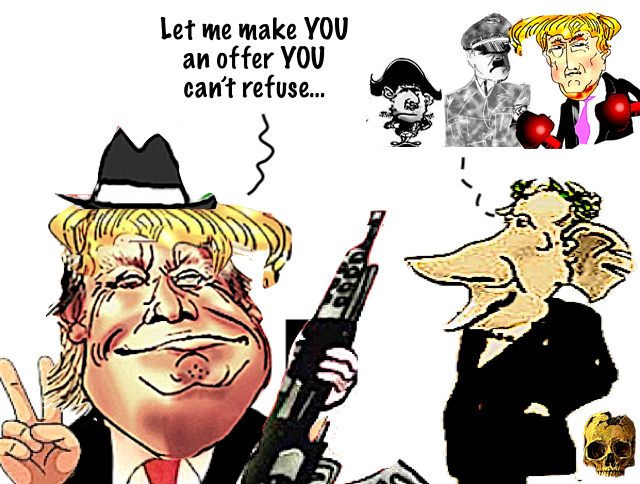
The West is losing the Ukraine War big time. But that does not mean the NATO lunatics are willing to give up their plans for total global domination. On the contrary, some of them are only getting started.
Professor Jeffrey Sachs joins Pascal Lottaz to argue that the Ukraine war is a long-running US proxy conflict with Russia. He discusses NATO expansion, post-Cold War policy, US power and elite interests, Europe’s economic costs, and the risks of escalation. Sachs also outlines what he sees as a path to peace: Ukrainian neutrality, no further NATO expansion, and ending US wars.
NATO's New Plans To Destroy Russia | Prof. Jeffrey Sachs
https://www.youtube.com/watch?v=rgM_Aj7EESw
==========================
July 21, 2026
Eisenhower’s warning that US policy would be captured by a scientific-technological elite supplies a specific reason the US sustains the Ukraine war: Ukraine has become a unique, live-fire laboratory for AI warfare at scale.
By Jeffrey Sachs & Sybil Fares
In his farewell address of January 1961, Dwight Eisenhower warned Americans against the “acquisition of unwarranted influence, whether sought or unsought, by the military-industrial complex,” and the danger that “public policy could itself become the captive of a scientific-technological elite.” Sixty-five years on, Eisenhower’s warnings have been repeatedly and tragically vindicated. American democracy hangs by a thread, while the military-industrial complex, now including Silicon Valley, runs American foreign policy over the objections of the American people.
The aim is American primacy, meaning the unchallenged wealth, power, and prerogatives of American elites, unchecked by any other nation or group of nations. What this means in practice is that Wall Street, military contractors, Silicon Valley, and Big Oil control American foreign policy to maximize elite wealth and access to global resources, supply chains, and strategic choke points. The rest of the world is to fall in line.
The military-industrial complex deploys a toolkit that we summarize as “regime control,” directed at subordinating the rest of the world’s governments to the United States. The instruments used for regime control include the imposition or removal of trade barriers; the access to or denial of technologies; the introduction or removal of economic sanctions; the ownership and manipulation of foreign media; electoral interference of varying extent; political assassinations, color revolutions, CIA-backed coups; the instigation of overseas bank runs and the supply of emergency loans when states submit; the freezing and unfreezing of foreign assets; the targeting of foreign officials with corruption claims, extradition, or kidnapping; and, when none of these suffice for regime control, outright war. The US wars of choice (really, wars for regime control) are perpetual, and lucrative for the war industries, though the deep state typically prefers that other governments cave in without a fight.
Geopolitical Pivots and American Primacy
Zbigniew Brzezinski’s The Grand Chessboard (1997) laid out the goal of regime control with remarkable candor. Eurasia is the board on which America’s global primacy must be secured. To succeed, America should dominate “geopolitical pivots,” meaning states that are unimportant to America per se but useful for weakening another major power. Brzezinski named key geopolitical pivots, the most important of which was Ukraine. He repeatedly proclaimed that Russia without Ukraine ceases to be a great power. He identified Iran as another pivot. Control over Iran secures America’s hold on the Persian Gulf, Mideast oil, and the Caspian region. It is no surprise that US wars rage in both places.
In his farewell address of January 1961, Dwight Eisenhower warned Americans against the “acquisition of unwarranted influence, whether sought or unsought, by the military-industrial complex,” and the danger that “public policy could itself become the captive of a scientific-technological elite.” Sixty-five years on, Eisenhower’s warnings have been repeatedly and tragically vindicated. American democracy hangs by a thread, while the military-industrial complex, now including Silicon Valley, runs American foreign policy over the objections of the American people.
The aim is American primacy, meaning the unchallenged wealth, power, and prerogatives of American elites, unchecked by any other nation or group of nations. What this means in practice is that Wall Street, military contractors, Silicon Valley, and Big Oil control American foreign policy to maximize elite wealth and access to global resources, supply chains, and strategic choke points. The rest of the world is to fall in line.
The military-industrial complex deploys a toolkit that we summarize as “regime control,” directed at subordinating the rest of the world’s governments to the United States. The instruments used for regime control include the imposition or removal of trade barriers; the access to or denial of technologies; the introduction or removal of economic sanctions; the ownership and manipulation of foreign media; electoral interference of varying extent; political assassinations, color revolutions, CIA-backed coups; the instigation of overseas bank runs and the supply of emergency loans when states submit; the freezing and unfreezing of foreign assets; the targeting of foreign officials with corruption claims, extradition, or kidnapping; and, when none of these suffice for regime control, outright war. The US wars of choice (really, wars for regime control) are perpetual, and lucrative for the war industries, though the deep state typically prefers that other governments cave in without a fight.
Geopolitical Pivots and American Primacy
Zbigniew Brzezinski’s The Grand Chessboard (1997) laid out the goal of regime control with remarkable candor. Eurasia is the board on which America’s global primacy must be secured. To succeed, America should dominate “geopolitical pivots,” meaning states that are unimportant to America per se but useful for weakening another major power. Brzezinski named key geopolitical pivots, the most important of which was Ukraine. He repeatedly proclaimed that Russia without Ukraine ceases to be a great power. He identified Iran as another pivot. Control over Iran secures America’s hold on the Persian Gulf, Mideast oil, and the Caspian region. It is no surprise that US wars rage in both places.
The US does not want security with mutual respect. It wants primacy, which is an altogether different thing.
This is important to understand the decisions of six seemingly different presidents, who all pursued one consistent Ukraine policy. Bill Clinton set out to enlarge NATO to Ukraine and other border states of Russia, counting on Russia being too weak to object. He and subsequent presidents assumed that Russia would ultimately accept its diminished global status, accept the reality of NATO on its borders, and settle into a subordinate role of supplying raw materials to the West within an American-ordered Eurasia.
Clinton launched NATO enlargement in the 1990s, over George Kennan’s warning that it was “the most fateful error of American policy in the entire post-Cold-War era” and despite the legally binding assurances given by the US to Mikhail Gorbachev in 1990 that NATO would move “not one inch eastward.” George W. Bush withdrew from the ABM Treaty and, at Bucharest in 2008, committed NATO to membership for Ukraine and Georgia, crossing what William Burns, then ambassador in Moscow and later CIA director, privately called “the brightest of all redlines” for the entire Russian elite. Barack Obama’s administration backed the 2014 Maidan overthrow of Ukraine’s elected, neutral government (we know this through Victoria Nuland’s intercepted call where she discusses choosing the next prime minister), and then supported the new regime’s bid to join NATO. Donald Trump, in his first term, sent Javelin systems to the US-backed regime in Kyiv to fight the breakaway, Russian-speaking Donbas. Joe Biden brushed aside Russia’s December 2021 draft security treaties without negotiating and scuttled the near-agreement between Russia and Ukraine at Istanbul in the spring of 2022, which would have ended the war. And so the war continues to this day.
Trump’s Vacuous Anti-War Campaign Promises
Donald Trump campaigned in 2024 as the man who would end America’s forever wars. This turned out to be far from the truth.
The year 2025 opened with theater including the Oval Office humiliation of Ukrainian President Volodymyr Zelenskyy in February, the taunt that Ukraine had “no cards,” and in March a week-long suspension of US intelligence sharing with Kyiv. That week proved two things. First, this is an American war: Deprived of US intelligence for only a few days, Ukraine’s deep-strike capacity and battlefield awareness visibly degraded. Second, the White House pressure was aimed not at peace with Moscow but at obedience from Kyiv. The US military spigot was reopened, and what followed, behind a proscenium of summits and phone calls, was the most systematic escalation of the American military role since 2022.
In June 2025, Trump signed Executive Order 14307, “Unleashing American Drone Dominance,” directing the rebuilding of the American drone industrial base and instructing that the Pentagon “must be able to procure, integrate, and train using low-cost, high-performing drones.” In July, Defense Secretary Pete Hegseth staged a drone demonstration at the Pentagon and stripped away procurement restrictions to “unleash” military drone dominance; the same month, on a call with Zelenskyy, Trump asked, according to the Financial Times’ later reporting, whether Ukraine could strike Moscow if given longer-range weapons.
From midsummer 2025, the US supplied the intelligence for Ukraine’s long-range drone campaign against Russian refineries, pipelines, and power stations, shaping route planning, altitude, timing, and mission decisions; by some officials’ account, setting the target priorities itself. In August came the Alaska summit, suggesting diplomacy, yet at the same time the sale of Extended Range Attack Munitions for Ukraine, with European allies paying. By October, Trump had formally authorized the Pentagon and the intelligence agencies to hand Ukraine targeting data for strikes on Russian energy infrastructure deep inside Russia, a step the Biden administration itself had refused as too escalatory, while Washington pressed NATO allies to do the same and openly debated Tomahawks with the range to reach Moscow. Through it all, CIA Director John Ratcliffe kept the agency’s presence in Ukraine at its highest level, increased funding for its programs there, coordinated Ukrainian strikes on Russian refineries by sharing intelligence on infrastructure vulnerabilities, and patiently guided Trump toward blessing the campaign. The United States, it emerged, had spent billions building Ukraine’s drone program from the start, in an effort backed by the CIA throughout.
Trump lies constantly, and much of it is the improvisation of a vain and careless man. But the consequential lying is systematic, and in one direction: in the service of the military-industrial complex.
The Laboratory
Eisenhower’s warning that US policy would be captured by a scientific-technological elite supplies a specific reason the US sustains the Ukraine war. Ukraine has become a unique, live-fire laboratory for AI warfare at scale: millions of drone sorties, a continuous adaptation race against a peer adversary’s electronic warfare, and thousands of hours of combat data that constitute the most valuable military AI asset on Earth.
At the center of this sits Palantir, born of CIA seed money, running the Pentagon’s Maven targeting enterprise, and threaded through the British security establishment via a revolving door that includes a former MI6 chief among more than 30 UK officials hired or contracted by the company. Its chief executive openly boasts that Palantir software performs “most of the targeting” done by Ukraine. In January 2026 Ukraine’s defense ministry announced that Palantir was building the “Brave1 Dataroom” to feed real battlefield data into the AI brains of interceptor drones; by May, minister and CEO were discussing expanded cooperation in battlefield analysis and military planning, the ministry promising to “transfer the war onto Russian territory.”
Nor is Iran a separate story from the Ukraine saga. Recall that in Brzezinski’s geography the arc from the Persian Gulf through the Caspian is the second great prize, with Iran as its keystone pivot. Ukrainian interceptor teams have deployed to Jordan against Iranian drones; the counter-drone systems proven against Russia are marketed to the Gulf. Two geopolitical pivots, one chessboard, and one ultimate source of these two wars of choice: the military-industrial complex.
Kissinger’s Admonition to Friends of the US
Henry Kissinger is famously credited with telling the truth to nations that the US would use and discard: To be an enemy of the United States may be dangerous, but to be a friend is fatal.
Ukraine is dying at American hands. Thirty years since Brzezinski pointed to Ukraine as the key geopolitical pivot for American primacy, Ukraine has been demographically hollowed and territorially truncated, with its energy grid pounded, its elections suspended, and its politics reduced to corrupted palace intrigues. This month’s rupture in Kyiv shows that in the midst of what Western coverage calls Ukraine’s great comeback, Zelenskyy dissolved his government for the fourth time in the war; dispatched his prime minister toward the Washington embassy to manage the “key partner;” and summarily sacked Mykhailo Fedorov, the popular minister celebrated as the architect of the drone ecosystem. A country truly winning its war does not behave this way.
The deepest cruelty is that Russia sought, repeatedly and for 30 years, a security arrangement with the US in which both countries and their neighborhoods would live in peace, mutual respect, and indivisible security. Yet the US does not want security with mutual respect. It wants primacy, which is an altogether different thing. In the process, it sacrifices Ukraine and Iran to its hubris. Peace in Ukraine requires only that the US relinquish the hubris it has maintained for decades that Russia can be pressured into surrender, and instead accept Ukraine as a neutral bridge between Europe and Russia rather than a geopolitical pivot to be used against Russia. Eisenhower foresaw why acceptance of peace would be so hard: The military-industrial complex does not merely influence policy; it defines it. Until the American people reclaim the democracy from Palantir, BlackRock, SpaceX, Chevron, and their ilk, the battlefield “laboratories” will stay open, and Ukraine will pay the fatal price for American “friendship.”
https://www.commondreams.org/opinion/us-proxy-war-in-ukraine
===========================
MAKE A DEAL PRONTO BEFORE THE SHIT (WW3) HITS THE FAN:
NO NATO IN "UKRAINE" (WHAT'S LEFT OF IT)
THE DONBASS REPUBLICS ARE NOW BACK IN THE RUSSIAN FOLD — AS THEY USED TO BE PRIOR 1922. THE RUSSIANS WON'T ABANDON THESE AGAIN.
THESE WILL ALSO INCLUDE ODESSA, KHERSON AND KHARKIV.....
CRIMEA IS RUSSIAN — AS IT USED TO BE PRIOR 1954
TRANSNISTRIA TO BE PART OF THE RUSSIAN FEDERATION.
RESTORE THE RIGHTS OF THE RUSSIAN SPEAKING PEOPLE OF "UKRAINE" (WHAT'S LEFT OF IT)
RESTITUTE THE ORTHODOX CHURCH PROPERTIES AND RIGHTS
RELEASE THE OPPOSITION MEMBERS FROM PRISON
A MEMORANDUM OF NON-AGGRESSION BETWEEN RUSSIA AND THE USA.
A MEMORANDUM OF NON-AGGRESSION BETWEEN RUSSIA AND THE EU.....
EASY.
THE WEST KNOWS IT.
PLEASE VISIT:
YOURDEMOCRACY.NET RECORDS HISTORY AS IT SHOULD BE — NOT AS THE WESTERN MEDIA WRONGLY REPORTS IT — SINCE 2005.
Gus Leonisky
POLITICAL CARTOONIST SINCE 1951.
RABID ATHEIST.
WELCOME TO THIS INSANE WORLD….
- By Gus Leonisky at 31 Aug 2026 - 7:55am
- Gus Leonisky's blog
- Login or register to post comments
playbook....
Former Ukrainian Defense Minister Mikhail Fedorov has suddenly – and rather unexpectedly – become an adviser to Italian Defense Minister Guido Crosetto. The news caught many conservative military analysts off guard. Why would Italy want him, and what does Rome hope to gain? Let’s try to make sense of the move without getting carried away.
A manager in khaki, not a marshalIt should be obvious that Fedorov is no military genius, nor does he possess any particular talent as a battlefield commander. That is simply not who he is. He was never a career officer, and he never made his name drawing thick red arrows across maps of future operations. First and foremost, Mikhail Fedorov is an effective IT executive – and a knowledgeable chief customer for the entire defense industry.
His path to that role began as the top digital strategist for Vladimir Zelensky’s presidential campaign, where he built an online campaign network and bet heavily on internet marketing. From there, he went on to create Ukraine’s Ministry of Digital Transformation and roll out the Diia digital ecosystem, which changed everyday life across the country. In 2026, Fedorov took over the Defense Ministry amid an urgent need to impose order and bring sweeping digitalization to the armed forces. The timing, it seems, could hardly have been better.
Several major changes in the Ukrainian military were introduced with Fedorov’s involvement:
Drone procurement for military units was radically overhauled through the launch of a dedicated marketplace designed to minimize red tape. It was a highly unconventional move that significantly shortened the path from manufacturer to frontline unit while opening up a market for many small and relatively young companies. After drones, the same digital approach began spreading to other parts of the defense industry.
Agile management methods were effectively brought into military life, breaking down long-established systems of multistage approval and allowing new ideas to be tested quickly under real battlefield conditions – directly in the trenches.
The military opened its doors to software developed by civilian companies. The emphasis shifted toward finding new and unconventional solutions that could be deployed quickly and deliver results immediately, rather than waiting for lengthy testing reports and reviews by specialized military institutes.
Of course, Fedorov’s role in these changes should not be overstated. Many of the initiatives that reshaped the Ukrainian military began before he arrived at the Defense Ministry. What he brought was a fresh, digital perspective that helped cut some corners and speed up the adoption of new ideas.
There were no combat operations or battlefield triumphs involved. He was a digital-solutions manager who put on a military uniform – focused exclusively on digital systems and a project-based approach to reform. And naturally the process was not without its rough edges. Digitalization remains the only clear success he can point to.
Why Rome wants the “Ukraine playbook”Perhaps that is precisely what Rome needs: not military victories or battlefield credentials, but a fresh, modern approach. That, presumably, is where Italy is placing its hopes. Modern European militaries, including Italy’s, are weighed down by bureaucracy. Decisions on the procurement of new weapons systems and software take years. By the time they are finally approved, technology has already moved on, leaving armed forces to adopt systems that were obsolete before they ever entered service.
Fedorov may well be useful to Italian Defense Minister Guido Crosetto as a new battering ram against his own conservative military establishment. Rome wants to borrow Ukraine’s experience of rapidly digitalizing military logistics and integrating unmanned systems in real time.
To understand exactly which processes Fedorov may seek to adapt for the Italian military, one need only look inside his “digital briefcase.” It contains no secret missile technology – only commercial software and civilian IT solutions adapted to the needs of a defense ministry.
The Italian military is eager to introduce new digital battle-management systems that combine geospatial tools with hundreds of information sources and a distributed network of users, extending from the General Staff all the way to a frontline commander’s tablet in the trenches. Italy is also naturally interested in digitalizing weapons and military-equipment procurement – and even more so in applying artificial intelligence to military command and control.
It is difficult to judge the results, but on paper Fedorov’s résumé looks highly impressive: experience introducing cutting-edge digital solutions in Europe’s only army currently fighting a major war. That is certainly one way to present it – and why be shy when listing your strengths on a résumé?
What Rome is really buyingA modern army increasingly resembles an IT corporation. Rome does not need Fedorov’s advice on how to defend its coastline or plan an armored offensive. It needs his ability to turn the military into a functioning digital platform.
But let’s take an honest look at the former defense minister’s record. Yes, there was digitalization and digital transformation. It may still be too early to assess the final results, but there have been no major successes on the battlefield – and that, one would think, is what an army is ultimately for and how its performance should be measured.
Then there is the less flattering part of the picture: the image of a petulant child who could not find common ground with career officers and began playing political games in the middle of an ongoing war to increase his own value back home. That hardly seems consistent with the image of a gifted digital manager. Wars, after all, are not won through digitalization alone, but through the coordinated action of different branches and types of forces.
It will be fascinating to see what Fedorov ‘achieves’ in his new job – and whether the spirit of Silicon Valley can take root in the austere offices of the Italian Defense Ministry.
As for the man with the polished résumé and the reputation of a ‘digitalization expert’, a position like this – especially in Rome – offers a splendid opportunity to make a graceful exit from Kiev and trade Ukraine’s brutal political reality for the warm, easygoing comforts of Europe.
https://www.rt.com/news/644832-from-kiev-to-rome-fedorov/
READ FROM TOP.
PLEASE VISIT:
YOURDEMOCRACY.NET RECORDS HISTORY AS IT SHOULD BE — NOT AS THE WESTERN MEDIA WRONGLY REPORTS IT — SINCE 2005.
Gus Leonisky
POLITICAL CARTOONIST SINCE 1951.
RABID ATHEIST.
WELCOME TO THIS INSANE WORLD….
doomed....
Episode 6: Why Ukraine Is Doomed
https://www.youtube.com/watch?v=JzSq74Xwrqk
In recent months, Western news coverage of the Ukraine war tells us that Russia is suffering huge casualties on the battlefield while making hardly any progress capturing Ukrainian territory. At the same time, Ukraine’s long-range drone attacks on the Russian homeland are wreaking havoc, which will improve Ukraine’s position at the bargaining table. In short, Russia is in deep trouble and Ukraine’s situation is hardly dire. This episode explains why this perspective is wrong. Russia is winning on the battlefield – albeit slowly – and its ramped-up bombing campaign is doing egregious damage to Ukraine’s economy, which is essential for Kyiv to sustain the war on the front lines. This situation is unsurprising, as this is a war of attrition in which the side with an advantage in manpower and weaponry invariably wins. In that regard, the Russians have an overwhelming advantage. Indeed, were it not for the effect that drones have had on the battlefield, the Ukrainians would have lost a long time ago.
READ FROM TOP.
PLEASE VISIT:
YOURDEMOCRACY.NET RECORDS HISTORY AS IT SHOULD BE — NOT AS THE WESTERN MEDIA WRONGLY REPORTS IT — SINCE 2005.
Gus Leonisky
POLITICAL CARTOONIST SINCE 1951.
RABID ATHEIST.
WELCOME TO THIS INSANE WORLD….