Search
Recent comments
- keep out....
6 hours 9 min ago - gains/losses....
6 hours 29 min ago - reefs in peril....
7 hours 23 min ago - hippies....
10 hours 34 min ago - boycott....
12 hours 13 min ago - anti-zionistic....
17 hours 50 min ago - no thieving....
17 hours 56 min ago - sniffles....
18 hours 18 sec ago - grumpies....
18 hours 10 min ago - capitulation.....
20 hours 58 min ago
Democracy Links
Member's Off-site Blogs
the concept of a hierarchy between nations is purely western.....
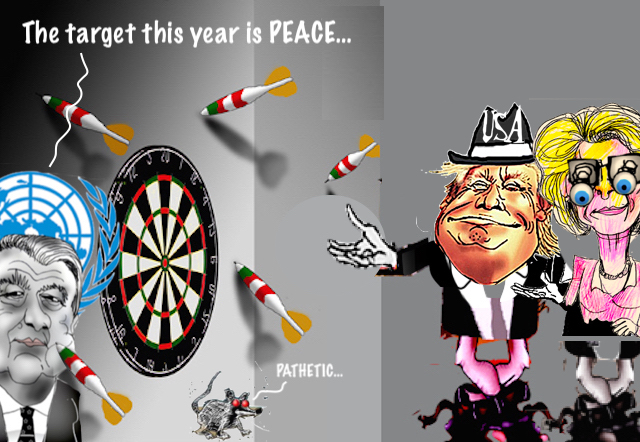
The compromise reached between Presidents Donald Trump and Vladimir Putin on August 15 has still not materialized in Ukraine. The obstacles are not those the United States anticipated. Ukraine is not cooperating, while Germany and the United Kingdom want war.
The Obstacles to Peace in Europe Are Not What We Think*
by Thierry Meyssan
President Donald Trump acknowledged to his counterpart Xi Jinping that he was his equal. Since World War II, every American president has considered himself superior to others because he was the most powerful and the richest.
Conversely, from a Chinese perspective, Xi Jinping considers himself the equal not only of Donald Trump, but of each of his counterparts. A Chinese person does not believe that having greater resources makes you superior.
This concept of a hierarchy between nations is purely Western. Therefore, the evolution of the US president should not be interpreted without considering the cultural context of the observer.
The following week, Russian President Vladimir Putin, in turn, visited Beijing. Western commentators asserted that the Russian was being held hostage by the Chinese. Again, this demonstrates a complete misunderstanding of their relationship. It is not the product of their respective interests, but of their shared history. From the sacking of the Summer Palace to the Nazi attempt to exterminate the Slavs, each has experienced how Westerners behave. They have concluded that they can only resist them by remaining united. It is therefore absurd to consider replicating what Richard Nixon and Henry Kissinger did in 1972: decoupling the two states.
At the Anchorage summit on August 15, 2025, Donald Trump and Vladimir Putin discussed doing business between their two countries and making peace in Ukraine. Despite several attempts, Washington failed because it wanted to sell weapons to the Europeans first. Today, it seems much more difficult, and the Europeans are beginning to manufacture their own.
President Trump has therefore begun withdrawing troops from Europe and abandoning the war that the Pentagon planned to extend to Transnistria and Bosnia and Herzegovina. He announced that he would withdraw at least 5,000 troops from Germany. Vladimir Putin, for his part, decreed that he would grant Russian citizenship to any adult Transnistrian who requested it. Finally, Donald Trump withdrew his support for the European Union High Commissioner who was administering Bosnia and Herzegovina in violation of the Dayton Agreement (1995). Simultaneously, his former Secretary of National Security, General Michael Flynn, is organizing US investments in the Serb-held area of Bosnia and Herzegovina.
These events suggest that the United States favors a peace in Ukraine that recognizes all of Novorossiya as Russian. This is historically and culturally justified, but it will only be possible by holding a referendum on self-determination. For the moment, Russian forces have no intention of liberating Odessa. The peace treaty could, however, acknowledge this.
Here again, contrary to what we believe, the difficulties do not lie where we perceive them.
The three main ones are now:
1) recognition of the Nazi ideology of the current government in Kyiv and the denazification of Ukraine;
2) recognition of the undemocratic nature of German reunification and the independence of East Germany;
3) recognition of the UK’s anti-Russian obsession and the dismantling of the European Defence Union before it is definitively formed.
UKRAINEEven though Western powers persist in believing that the Russian intervention in Ukraine is an attempt at annexation and the beginning of Russia’s westward expansion, Moscow never invaded its neighbor, but rather implemented Resolution 2202, which it had guaranteed before the Security Council.
To claim that Russia invaded Ukraine is as absurd as saying that France invaded Rwanda. We know that it intervened to end a genocide (for which it was partly responsible), in accordance with a Security Council resolution.
The current Ukrainian government is illegitimate. President Volodymyr Zelensky’s term expired long ago. Every three months, he extends martial law, which serves no other purpose than to prevent new elections. However, his latest decree on this matter extends martial law from May 2nd to August 4th. It would be possible to organize an election campaign and a vote during that time. However, the electoral lists will need to be cleaned up, as they still include soldiers killed in action and civilians who fled. No one knows their exact number, but they could represent between one and two-thirds of registered voters.
The Verkhovna Rada (parliament) is equally problematic. Only a third of the members participate. The laws it passes are therefore of dubious legitimacy. For example, it voted to destroy one hundred million books—on the grounds that they were signed by Russian authors or printed in Russia, without distinguishing between contemporary authors and literary classics. Similarly, this parliament banned the country’s main church and all opposition parties. Moreover, there is a CIA office within the Rada itself that drafts all the laws. The members present simply ratify them.
Russia’s primary demand is the denazification of Ukraine. This is what President Putin declared when launching his special military operation. From a Russian perspective, this is non-negotiable. Indeed, what defines the identity of the Russian Federation is not the memory of Catherine the Great, but that of the Soviet struggle against Nazism. This ideology aimed to annihilate the entire Slavic population (but neither the Jewish nor the Roma population), as explained in Mein Kampf. Even if we in the West are unaware of it, the Second World War was not waged to carry out the Holocaust, but to murder the Slavic population.
The Verkhovna Rada (parliament) is equally problematic. Only a third of the members participate. The laws it passes are therefore of dubious legitimacy. For example, it voted to destroy one hundred million books—on the grounds that they were signed by Russian authors or printed in Russia, without distinguishing between contemporary authors and literary classics. Similarly, this parliament banned the country’s main church and all opposition parties. Moreover, there is a CIA office within the Rada itself that drafts all the laws. The members present simply ratify them.
Russia’s primary demand is the denazification of Ukraine. This is what President Putin declared when launching his special military operation. From a Russian perspective, this is non-negotiable. Indeed, what defines the identity of the Russian Federation is not the memory of Catherine the Great, but that of the Soviet struggle against Nazism. This ideology aimed to annihilate the entire Slavic population (but neither the Jews nor the Roma population), as explained in Mein Kampf. Even if we in the West are unaware of it, the Second World War was not waged to carry out the Holocaust, but to murder the Slavic population.
Yet, the illegitimate administration of the unelected president Zelensky refuses any denazification measures. There are currently numerous monuments glorifying the Nazis and their collaborators, the "fundamental nationalists." The history of Ukraine was entirely rewritten by them, with the help of British MI6 and the American CIA, after the Second World War. This propaganda aims to make people believe that the "Banderists" fought the Nazis, which is absolutely false. No: the Banderites were Nazis.
Convinced that there will never be denazification, the "fundamental nationalists" are planning the construction of a Pantheon in their honor. General Kyrylo Budanov, head of the presidential administration, organized the repatriation of the remains of perpetrators of crimes against humanity, buried around the world during the Cold War, on March 28. Rob Jetten and Luc Frieden, the Dutch and Luxembourgish prime ministers, have already agreed to the transfer of the bodies of the fascist Yevhen Konovalets and the Nazi Andriy Melnyk.
GERMANYIn our minds, Germany is a democratic state that successfully reunified in 1990. However, as Dmitry Medvedev, Vice Chairman of the Security Council of the Russian Federation, recently stated, reunification is merely an illusion. West Germans never consulted East Germans. Under international law, reunification is invalid.
The 2025 federal elections produced different and opposing results in the former West and East Germany. West Germans voted for the CDU or SPD, while East Germans voted for the AfD. This is the sole reason why the first two parties are classified as "democratic" and the third as "far-right."
Yet, Chancellor Friedrich Merz (a Christian Democrat) has pursued a widespread crackdown on all those who challenge his authority, labeling them "conspiracy theorists." Relying on the Munich Office for the Protection of the Constitution (a branch of the federal body which housed many of the Reich police officials after the war), he banned several media outlets and imprisoned journalists.
Simultaneously, Germany is gradually rebuilding its army with financial assistance from the United Kingdom, just as its predecessor, Chancellor Adolf Hitler, rebuilt the German army with the help of the Governor of the Bank of England, Lord Montagu Norman. He has reinstated conscription for men and requires every volunteer to notify Berlin before going on holiday abroad.
Germany is also rebuilding its military-industrial complex, this time with European funds.
It is preparing for a war like the one in Ukraine, even though a war against Russia would be of a completely different nature. Regardless, the entire German industry is now producing Ukrainian drones and selling them in the Gulf against Iran. Following this logic, Berlin wants to bring Ukraine into the European Union, even though it does not meet the accession criteria set by the treaties: it would simply be a matter of creating a new status, that of "associate member," and the trick would be done. Having ignored the negative results of the 2005 French and Dutch referendums, this would be just another decision made against the will of the people.
Friedrich Merz, grandson of a Nazi dignitary, cannot imagine his country not being allied with the Ukrainian “fundamental nationalists,” nor holding accountable those who sabotaged the Nord Stream gas pipeline and caused the collapse of German industry.
THE UNITED KINGDOMSince the 19th century, the United Kingdom has perceived Russia as its sole rival, not only in Europe, but in the world. Lord Curzon, Viceroy of India, conceived the "Great Game," the colonization of Central Asia, in order to neutralize the Russian Empire. Today, British strategy remains unchanged.
London continues to portray Moscow as an obscurantist power. It is no longer a matter of fabricating the Zinoviev telegram (which allowed the Soviets to be accused of wanting to interfere in the UK elections), but of making people believe that the Kremlin’s occupant is a madman who has a passenger plane shot down in Ukraine and poisoned Sergei and Yulia Skripal or Alexei Navalny.
Its latest invention is the attack on European airports by unidentified drones. Regardless of the truth, London is using this to convince the North Sea states to join its Joint Expeditionary Force, which it has just transformed into a military alliance, the "Northern Marines," under its command. It hopes to bring all the member states of the European Union and Turkey into the alliance.
This is why the hereditary Lords—and there are still some—are doing everything they can to keep Keir Starmer in Downing Street. The Prime Minister is, in fact, a Labour member who is, in secret, an agent of big business: unbeknownst to his own party and the media, he attended meetings of the Rockefeller Trilateral Commission. Also unbeknownst to everyone, he appointed Peter Mandelson—an accomplice of the criminal Jeffrey Epstein—as Her Majesty’s ambassador to Washington.
The important thing is to maintain the illusion that the United Kingdom has no dealings with either the State of Israel or Hamas; to continue concealing the fact that Israeli chiefs of staff have been secretly visiting Whitehall throughout the Gaza genocide, in which the British army actively participated. It is better to claim, like Christian Turner, Peter Mendelson’s successor, that only one state has a "special relationship" with Washington: Israel.
Thierry Meyssan
Translation
Roger Lagassé
https://www.voltairenet.org/article224589.html
PLEASE VISIT:
YOURDEMOCRACY.NET RECORDS HISTORY AS IT SHOULD BE — NOT AS THE WESTERN MEDIA WRONGLY REPORTS IT — SINCE 2005.
Gus Leonisky
POLITICAL CARTOONIST SINCE 1951.
RABID ATHEIST.
WELCOME TO THIS INSANE WORLD….
*GUSNOTE: THIS ARTICLE IS 80 PER CENT THERE... WHAT WE THINK IS THAT "TRUMP WANTING PEACE IN UKRAINE" IS FALSE... TRUMP'S REMOVAL OF US TROOPS IN EUROPE IS A CROCK... THE TROOPS ARE SHIFTED FROM GERMANY TO POLAND.
TRUMP IS A PICKPOCKET... A CON MAN... HE'S BEEN TRYING TO CON PUTIN WITH A PEACE DEAL, WHICH TRUMP KNOWS WON'T HAPPEN BECAUSE THE EU AND THE UK ARE PLAYING BAD COP IN HIS GOOD-COP/BAD-COP ROUTINE... IF A PEACE DEAL ALLA-TRUMP HAPPENED, IT WOULD BE TO PREVENT RUSSIA TAKING MORE RUSSIAN TERRITORY FROM UKRAINE. AND THIS PEACE DEAL WOULD BE CONTESTED BY THE NAZIS IN KIEV AND THE OTHER FASCISTS [TRUMP IS A FASCIST] IN EUROPE.
RUSSIA [PUTIN] MEANWHILE WOULD KNOW THAT NATO/USA/UK/EU ARE DISHONEST, BUT PUTIN IS KEEPING THE HIGH MORAL GROUND, DESPITE A HOSTILE WESTERN MEDIA IN FAVOUR OF WAR....
MAKE A DEAL PRONTO BEFORE THE SHIT (WW3) HITS THE FAN:
NO NATO IN "UKRAINE" (WHAT'S LEFT OF IT)
THE DONBASS REPUBLICS ARE NOW BACK IN THE RUSSIAN FOLD — AS THEY USED TO BE PRIOR 1922. THE RUSSIANS WON'T ABANDON THESE AGAIN.
THESE WILL ALSO INCLUDE ODESSA, KHERSON AND KHARKIV.....
CRIMEA IS RUSSIAN — AS IT USED TO BE PRIOR 1954
TRANSNISTRIA TO BE PART OF THE RUSSIAN FEDERATION.
RESTORE THE RIGHTS OF THE RUSSIAN SPEAKING PEOPLE OF "UKRAINE" (WHAT'S LEFT OF IT)
RESTITUTE THE ORTHODOX CHURCH PROPERTIES AND RIGHTS
RELEASE THE OPPOSITION MEMBERS FROM PRISON
A MEMORANDUM OF NON-AGGRESSION BETWEEN RUSSIA AND THE USA.
A MEMORANDUM OF NON-AGGRESSION BETWEEN RUSSIA AND THE EU.....
EASY.
THE WEST KNOWS IT.
GUSNOTE: António GUTERRES, THE HEAD OF THE UNITED NATIONS, HAS TAKEN THE SIDE OF THE NAZIS...
- By Gus Leonisky at 28 May 2026 - 7:55am
- Gus Leonisky's blog
- Login or register to post comments
diplomulti....
Lawrence Wilkerson: America Is Failing to Adjust to a Multipolar World
ScheerPost Staff
Retired Colonel Lawrence Wilkerson delivers a stark warning about a world he believes is rapidly slipping beyond Washington’s control. In a sweeping conversation with Glenn Diesen, Wilkerson argues that the United States is failing to adapt to the rise of a multipolar order—one increasingly shaped by China’s strategic patience, Russia’s military escalation, and the collapse of diplomatic norms that once restrained global conflict.
From NATO expansion and the war in Ukraine to tensions with Iran and the erosion of trust between nuclear powers, Wilkerson paints a picture of leaders trapped in outdated imperial thinking while the geopolitical ground beneath them shifts dramatically. The result, he warns, is a dangerous mix of technological upheaval, declining U.S. influence, and political desperation that could push the world toward catastrophic confrontation.
Wilkerson paints a picture of leaders sleepwalking toward catastrophe while convincing themselves they are preserving peace. And as the former insider surveys the accelerating breakdown of global stability, he leaves viewers with a chilling admission: “I hope I’m wrong more than anyone.”
world he believes is rapidly slipping beyond Washington’s control. In a sweeping conversation with Glenn Diesen,
Retired Colonel Lawrence Wilkerson does not sound like a man who believes the world is stabilizing. In a sweeping and deeply unsettling conversation with Glenn Diesen, Wilkerson paints a portrait of a global order entering a dangerous transition — one in which the United States remains trapped in the mindset of unipolar dominance even as the foundations of that dominance visibly erode.
For Wilkerson, the central reality shaping the 21st century is simple: power is moving eastward, and Washington either cannot or will not accept it.
“China is winning and doesn’t want to do anything to interrupt that victory.”
That observation becomes the organizing principle of the interview. While China, in Wilkerson’s view, pursues long-term strategic patience, the United States appears increasingly reactive, erratic and unable to adapt to a multipolar world it no longer fully controls.
Diplomacy Without DiplomacyOne of the most striking parts of the discussion centers on the collapse of diplomacy itself.
Wilkerson repeatedly emphasizes that genuine negotiations between Washington and Tehran barely exist. According to him, there have been no meaningful face-to-face talks between senior American and Iranian officials, only intermediaries passing messages between hostile states.
For Wilkerson, this is not merely incompetence — it is historically dangerous.
“The first ingredient in diplomacy is trust.”
Without direct dialogue, he warns, every “peace process” becomes theater. Every ceasefire becomes temporary. Every negotiation risks becoming little more than cover for the next escalation.
He predicts that the United States could once again drift toward military confrontation with Iran after another failed diplomatic spectacle — a cycle he believes has already repeated itself multiple times.
Ukraine as a Laboratory of WarWilkerson’s analysis of Ukraine is equally bleak.
Rather than viewing the conflict strictly through the lens of democracy versus authoritarianism, he argues that powerful Western states increasingly see Ukraine as a battlefield laboratory — a place to experiment with advanced military technologies, drone warfare, electronic warfare systems and new methods of combat.
The comparison he reaches for is chilling:
“We’re like Hitler in 1936 in Spain watching those Stukas dive and amending their performance accordingly.”
The implication is clear: major powers are learning from Ukraine in preparation for future wars, not necessarily trying to end the current one.
At the same time, Wilkerson warns that Russia appears to be preparing psychologically and strategically for a direct confrontation with NATO itself. He points to Moscow’s recent nuclear exercises and escalating rhetoric as evidence that the Kremlin increasingly sees conflict with the alliance as inevitable.
The Collapse of Strategic ThinkingThroughout the interview, Wilkerson repeatedly returns to one idea: America no longer appears capable of coherent grand strategy.
Donald Trump, in Wilkerson’s telling, governs impulsively, driven more by personal instinct and political survival than any consistent geopolitical doctrine. Yet Wilkerson reserves criticism not just for Trump, but for the broader American foreign policy establishment — intelligence agencies, defense contractors, ideologues and political elites who continue acting as though the United States still exists in the uncontested post-Cold War moment of the 1990s.
The result is a dangerous contradiction:
For Wilkerson, this is not deterrence. It is provocation masquerading as stability.
“What provides deterrence… is diplomacy.”
That line cuts directly against the dominant assumptions now driving much of Western foreign policy. Wilkerson argues that military buildups without trust merely intensify paranoia and insecurity on all sides.
Technology, Decline and Nuclear DangerPerhaps the most haunting sections of the interview concern the speed of technological change and its implications for war.
Wilkerson argues that warfare is evolving faster than political institutions can comprehend. Drone swarms, electronic warfare systems, microwave defenses and AI-assisted battlefield technologies are reshaping military realities at extraordinary speed. Traditional concepts of deterrence, escalation and even victory may no longer apply.
At the same time, he believes the United States is confronting something it has not faced in generations: relative decline.
In Wilkerson’s framework, the world now contains:
That combination, he warns, is historically combustible.
“There’s never been a time… that we were closer to the use of these weapons than now.”
Unlike many Cold War analysts who relied heavily on historical parallels, Wilkerson argues today’s environment may be even more dangerous precisely because it is unprecedented. Technology is changing too rapidly. Political leadership is weaker. Diplomacy is collapsing. And nuclear powers are communicating less, not more.
The Generational ShiftOne of the more revealing sections of the discussion arrives near the end, when Wilkerson turns toward demographics and generational politics.
He argues that younger generations across Asia — and increasingly across the world — no longer see the United States as a stabilizing force. American military presence abroad, particularly after Gaza and years of endless wars, has deeply damaged Washington’s global legitimacy among younger populations.
He specifically points to South Korea, Japan and the Philippines as countries where younger generations are steadily becoming more skeptical of permanent alignment with the United States.
That generational divide, he suggests, may ultimately reshape global alliances more dramatically than any battlefield.
A System Unable to AdjustWhat makes Wilkerson’s warnings so unsettling is not simply his fear of war. It is his suggestion that the political class driving the current order may be psychologically incapable of adjusting to a world where the United States no longer dominates uncontested.
Again and again, the conversation returns to the same contradiction:
The global balance of power is changing, but Western institutions continue behaving as though nothing fundamental has changed at all.
The danger, Wilkerson implies, is not merely miscalculation. It is denial.
And denial inside nuclear-armed empires has historically ended catastrophically.
By the interview’s conclusion, even Wilkerson appears exhausted by the scale of the crisis he is describing. Asked whether the world may be drifting toward a larger war, he does not offer reassurance.
Instead, he offers a grim acknowledgment that perhaps defines the entire discussion:
“I hope I’m wrong more than anyone.”
: At a moment when the once vaunted model of responsible journalism is overwhelmingly the play thing of self-serving billionaires and their corporate scribes, alternatives of integrity are desperately needed, and ScheerPost is one of them. Please support our independent journalism by contributing to our online donation platform, Network for Good, or send a check to our new PO Box. We can’t thank you enough, and promise to keep bringing you this kind of vital news.
https://scheerpost.com/2026/05/27/lawrence-wilkerson-america-is-failing-to-adjust-to-a-multipolar-world/
READ FROM TOP.
PLEASE VISIT:
YOURDEMOCRACY.NET RECORDS HISTORY AS IT SHOULD BE — NOT AS THE WESTERN MEDIA WRONGLY REPORTS IT — SINCE 2005.
Gus Leonisky
POLITICAL CARTOONIST SINCE 1951.
RABID ATHEIST.
WELCOME TO THIS INSANE WORLD….
status quo ante....
Glenn Diesen: […] The Europeans are talking about NATO, establishing a NATO without the US – a different NATO, that is – and at the same time, as you’re seeing the situation [in Ukraine] getting worse, the Europeans still appear to be escalating.
That is, these massive drone programs they’re sending to Ukraine, seemingly allowing their territory to be used to strike Russia’s Baltic coast. And yeah, we now see that Russia is essentially warning that all of these factories producing all these drones are considered now legitimate targets. Where do you see all of this going? Because they seem – I don’t want to say, I’m wondering how to describe this best – there seems to be some massive, not panic, but delusion. I’m not sure what is a good word to describe what is happening in Europe now. But it’s, yes, there’s not much strategic thinking. It’s just this obsession with defeating Russia. Yet the weapons are drying up. Lack of capability seems to be compensated with more belligerent language and dismissing all the red lines. So where do you think this will take us?
Douglas Macgregor: Well, my perception is that the misrepresentation of Russia’s true intentions, which never had anything to do with conquering anybody anywhere, is going to vanish in an energy crisis that the current governments in Western Europe in particular can’t master. I think that’s the final straw. The globalist leaders who want to maintain this war against Russia will be unable to do so because they’ll be thrown out of office. I’m still surprised that we have not seen open revolution in places like Germany and Great Britain. I think we will in the future. The situation in England, Scotland, Ireland, and Wales is really bad. We’ve already seen the Irish come out into the streets. I think we’re going to see more of that.
They [the protests in Ireland] may be the canary in the coal mine for the British Isles. I hope so. But the people that are running the show in Parliament are simply out of touch with reality. They recently refused licensing for more drilling in the North Sea, even though they know that the oil deposits there are enormous and the need for energy is overwhelming. But we’re still dealing with these people that live in this illusory world where wind and solar power are going to replace carbon-based energy. It’s not going to happen, not this way. I mean, perhaps at some point Tesla’s dream of harvesting energy from the atmosphere will work. But in the meantime, we have to use what we’ve got. We’ve got to survive on that. I think Europeans are concluding that. And I think in Germany, eventually you’re going to see a return to the status quo ante, which is these people that are running things are going to be gone, and they’re going to have to restart nuclear power plants. And they’re going to have, once they’ve thrown these people out, they’re going to have to come to terms with Moscow. And they should. Again, everything – all the abuse, the insults, and the lies hurled at Moscow – has to be fundamentally dismantled. It’s very hard to do when the media is controlled by these globalist governments. The media has not told the truth. They portrayed Ukraine as a sort of luminous group of patriots fighting desperately for their freedom. That’s a lot of nonsense. Ukrainians were built up for the purpose of attacking Russia by us. We encouraged this. We cultivated it.
When I say “us”, I’m talking about us and the Europeans. NATO is finished – exactly what I thought would happen at the beginning of this crisis in January of 2022. And I said so. NATO is done. Europeans must find a way forward for themselves that makes sense. And I think eventually this will happen. I hope sooner rather than later, because President Putin has restrained the use of Russian military power. He’s held it back. He has everything he needs to finish this war decisively this year. There’s no question about that. He also has the means to flatten substantial areas in the Baltic states, in Germany, Poland, elsewhere – anywhere in Great Britain, for that matter – where they’re manufacturing these drones to be hurled against Russian infrastructure and against Russian citizens. He has sat on all of this. He has declined to do those things.
He’s held the force back. The Russians want to do it. He doesn’t. I hope that European governments will outpace the Russian desire for action. I really do, because it would be disastrous for that war to unfold in Europe. And the Europeans today, they’ve lost their fear of war. They don’t understand just how bad it can be. And I think these governments, once they’re replaced, new people will come in and they’ll behave differently. And this man, Zelensky, and the corruption in that regime, its underpinnings, which are, you know, the worst imaginable criminality, they have to be revealed. The truth has to come out. •
https://www.zeit-fragen.ch/en/archives/2026/no-9-5-may-2026/what-becomes-of-europe
READ FROM TOP.
PLEASE VISIT:
YOURDEMOCRACY.NET RECORDS HISTORY AS IT SHOULD BE — NOT AS THE WESTERN MEDIA WRONGLY REPORTS IT — SINCE 2005.
Gus Leonisky
POLITICAL CARTOONIST SINCE 1951.
RABID ATHEIST.
WELCOME TO THIS INSANE WORLD….
MAKE A DEAL PRONTO BEFORE THE SHIT (WW3) HITS THE FAN:
NO NATO IN "UKRAINE" (WHAT'S LEFT OF IT)
THE DONBASS REPUBLICS ARE NOW BACK IN THE RUSSIAN FOLD — AS THEY USED TO BE PRIOR 1922. THE RUSSIANS WON'T ABANDON THESE AGAIN.
THESE WILL ALSO INCLUDE ODESSA, KHERSON AND KHARKIV.....
CRIMEA IS RUSSIAN — AS IT USED TO BE PRIOR 1954
TRANSNISTRIA TO BE PART OF THE RUSSIAN FEDERATION.
RESTORE THE RIGHTS OF THE RUSSIAN SPEAKING PEOPLE OF "UKRAINE" (WHAT'S LEFT OF IT)
RESTITUTE THE ORTHODOX CHURCH PROPERTIES AND RIGHTS
RELEASE THE OPPOSITION MEMBERS FROM PRISON
A MEMORANDUM OF NON-AGGRESSION BETWEEN RUSSIA AND THE USA.
A MEMORANDUM OF NON-AGGRESSION BETWEEN RUSSIA AND THE EU.....
EASY.
THE WEST KNOWS IT.
pissy UN....
MOSCOW (Sputnik) - There has been no response from the UN, the Organization for Security and Cooperation in Europe (OSCE), or other international organizations to Russia's appeals regarding the Ukrainian strike on Starobelsk, Russian Human Rights Commissioner Yana Lantratova told Sputnik.
Lantratova previously reported that she had sent letters to the UN High Commissioner for Human Rights, the OSCE Secretary General, the President of the UN Human Rights Council, and other international organizations regarding the Ukrainian strike on a college and dormitory in the Lugansk People's Republic (LPR).
"We sent letters immediately after the tragedy occurred. We have not yet received any response. We are awaiting it, and hope for an objective assessment of these events by the international public... We hope for a response, and moreover, we will send [letters] to all our counterparts in various countries around the world so that people know the truth," Lantratova said.
On May 22, Ukrainian forces attacked an academic building and a dormitory of the Starobelsk Professional College of Lugansk State Pedagogical University. Twenty-one people were killed and 44 others wounded.
https://sputnikglobe.com/20260528/no-response-from-un-osce-to-appeals-regarding-ukrainian-strike---russian-ombudswoman-1124204449.html
READ FROM TOP.
PLEASE VISIT:
YOURDEMOCRACY.NET RECORDS HISTORY AS IT SHOULD BE — NOT AS THE WESTERN MEDIA WRONGLY REPORTS IT — SINCE 2005.
Gus Leonisky
POLITICAL CARTOONIST SINCE 1951.
RABID ATHEIST.
WELCOME TO THIS INSANE WORLD….