Search
Recent comments
- "west failure"....
30 min 39 sec ago - unacceptable.....
13 hours 31 min ago - CIA vs MI6.....
13 hours 46 min ago - lindsey in hell....
14 hours 15 min ago - human thingies....
17 hours 10 min ago - musk's appeal....
18 hours 35 min ago - dresden....
21 hours 12 min ago - ethanol....
22 hours 6 min ago - sweet slavery....
22 hours 12 min ago - in a wheelchair?....
1 day 11 hours ago
Democracy Links
Member's Off-site Blogs
the new kingdom of super algorithms.....
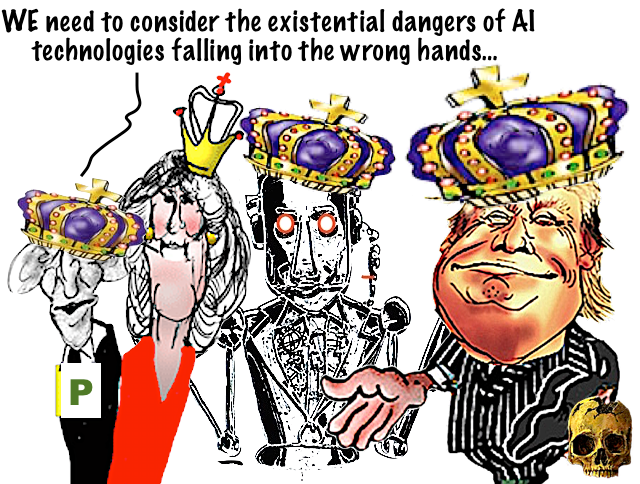
King Charles III has warned of the challenges disinformation and other "hostile online activity" pose to trust and security in the digital age.
The comments, made in a letter to the National Cyber Security Centre (NCSC) to mark its 10th anniversary, spoke of "malicious actors" continuing to "evolve their tactics by using automated technologies".
"From threats to our international order, to the need to balance the risks and opportunities of powerful new technologies, strong cyber security is fundamental to making the online environment safer and more resilient," he wrote.
Last month, the King warned AI executives of the "existential dangers" posed by the technology falling into the wrong hands.
In the letter published on Saturday by NCSC, the King praised the government agency. He said its achievements over the past decade have included defending the country against cyber attacks, safeguarding democratic institutions and protecting "the critical infrastructure upon which daily life depends".
"You have built resilience across our public services, businesses and communities, equipping us all to prosper in our ever-evolving digital world," the monarch added.
The King said he was "acutely aware" that much of the work done by the NCSC cannot be praised publicly and that he was filled with "profound gratitude".
The NCSC was established in 2016 as part of the Government Communications Headquarters to protect the UK against cyber threats.
Earlier this week, the NCSC offered assistance to online shopping store Asos after customers received a notification from its app sent by hackers, the BBC understands.
The high profile hack made global headlines on Tuesday when cyber criminals used Asos's own app system to send a pop up notification to potentially millions of people.
Asos said it was investigating "unauthorised activity" involving third-party platforms. The company told its customers that hackers are in possession of detailed profiles of potentially millions of the company's users - including names, addresses, phone numbers, emails, customer numbers and dates of birth.
It issued the update after BBC News told the retailer it had been contacted by cyber criminals who said this week's breach went beyond the "basic contact details" Asos previously said might have been accessed.
The letter from the King to NCSC came after he spoke to AI executives at Dumfries House in Ayrshire last month on how the tech can be used to benefit security.
The meeting followed a series of recent warnings from people inside the industry about the rapidly evolving capabilities of advanced or "frontier" AI models and the regulation needed to keep them in check.
"Those who have created these technologies are now increasingly warning that AI risks developing darker capacities - perhaps even to take life," the King told the executives.
He said there seemed to be an "urgency" in "adequately considering the existential dangers of such technologies falling into the wrong hands, and being used in potentially catastrophic ways".
"The task before you is not merely to advance technology, but to ensure that it remains firmly in the service of humanity, community and the natural world," he told the group.
https://www.bbc.com/news/articles/cme3xl7d18z2o
=====================
MEANWHILE:
Trump’s power is fading, but his AI gamble could still reshape the world
Donald Trump remains globally consequential, but his ability to bend other governments and institutions to his will is diminishing. AI is the major exception, where deregulation could unleash risks that outlast his presidency.
At the UN General Assembly last month, US President Donald Trump delivered a victory speech. A decade after telling his supporters that he’d stack so many victories that “you may even get tired of winning”, he offered a list of successes, including the settlement of eight wars, action against “the bully of the Middle East” in Iran, a deal with Denmark on Greenland, and the arrest of Venezuela’s “outlaw dictator”, Nicolás Maduro.
To Trump’s credit, some of these wins are significant. He has presided over a fragile but important ceasefire in Gaza, and his intervention in Venezuela, while in contravention of international law and now framed primarily around the ‘spoils’ of the country’s resources, did remove a longstanding US adversary and created the possibility (even if far off) of free and fair elections for the first time in more than ten years.
But his speech also revealed something else: the growing limits on his power as he enters the lame-duck stage of his presidency, experiences collapsing approval ratings, and interacts with leaders whose tenures will extend far beyond his own. Previously the most powerful, unpredictable force on the international stage, Trump has now passed the peak of his ability to disrupt the international order.
The evidence of Trump’s fading influence can be found across his top priorities: tariffs, the Iran war, and immigration enforcement. Earlier this year, the Supreme Court struck down his use of emergency powers to institute tariffs, and even before that decision, Trump was confronted with the limits of his power in his brief trade war with China, which responded to his 145 per cent tariff rate with a 125 per cent rate of its own and a halt on critical mineral exports.
As a result, Trump has not only moderated his policies on China; he has almost entirely reversed his position, rolling out the red carpet for Chinese President Xi Jinping during his recent visit to Washington. Trump even greeted Xi at the airport – the first time an American leader has offered such a welcome for a state visit since 1962 – and offered to sell China weapons (in violation of US law).
Similarly, when Trump attempted to ratchet up trade pressure on Canada, Canadian Prime Minister Mark Carney responded with retaliatory tariffs and a new ‘middle-power’ strategy. Although Trump correctly saw that he held economic leverage over Canada (with over 70 per cent of Canadian exports going to the US), he underestimated the power imbalance between himself, as an unpopular leader with only two years left in his term, and Carney, whose 60 per cent-plus approval could keep him in office for years to come. Now, Canada is thinking even bigger, forging a closer connection with the European Union and attempting to bring other countries, such as Australia and the United Kingdom, along with it.
Trump has run into similar limits in the Iran war. After attempting to engineer a rapid regime change without the boots on the ground required to do so, his administration was surprised by the Iranian seizure of the Strait of Hormuz and has found itself unable to reach a durable agreement to reopen it. Worse, Trump’s task in resolving the war has been further complicated by the fact that the Iranians no longer trust American agreements. It was Trump, after all, who ripped up US President Barack Obama’s original nuclear deal and then attacked Iran while it was actively negotiating a new one.
Iran’s strategy now is to wait Trump out, hoping that the economic pressure from closing the Strait and his fading political capital will eventually force him to offer greater concessions. Trump has tried to signal that he will not back down – by threatening to “annihilate” the country, emphasising that a loss in the midterms will not alter his strategy, and dispatching new forces to the Middle East – but Iran remains unmoved.
Domestically, Trump’s flagship immigration policies are facing pushback as well. Earlier this year, Operation Metro Surge in Minnesota triggered such widespread unrest that Border Czar Tom Homan had to end the initiative. Now, congressional Republicans, many of whom are running for re-election this November and facing long odds as a result of Trump’s sagging approval ratings, are breaking from him. Even Jim Justice, a longtime Trump ally in the Senate who is considering a run for governor of West Virginia, is arguing that the administration is “doing something wrong” with its immigration policy.
Trump of course remains a consequential figure on the global stage, since he is in charge of the world’s most powerful military, and can point to a dynamic domestic economy. But with the gulf between his ambitions and capabilities widening, the level of global risk associated with him is declining in all areas except for one: AI, where his capacity to disrupt the global order is growing.
Trump has ruled out regulation on AI in order to ‘win’ the race against China, despite increasingly frequent safety incidents (from users’ attempts to develop bioweapons to hacking sprees) documented by US companies like OpenAI and Anthropic. In doing so, he has created a near certainty that an AI-fuelled crisis will emerge sooner or later. Like his actions on trade, Iran, and immigration enforcement, such a development will spiral in ways that are currently unforeseeable, ultimately offering still more proof of the limits of his power in the final years of his presidency.
PLEASE VISIT:
YOURDEMOCRACY.NET RECORDS HISTORY AS IT SHOULD BE — NOT AS THE WESTERN MEDIA WRONGLY REPORTS IT — SINCE 2005.
Gus Leonisky
POLITICAL CARTOONIST SINCE 1951.
RABID ATHEIST.
WELCOME TO THIS INSANE WORLD….
- By Gus Leonisky at 12 Oct 2026 - 5:55am
- Gus Leonisky's blog
- Login or register to post comments
"west failure"....
Robin Brown, Gregory Andrews
AI and the limits of sovereignty, Part One: Why national rules are not enoughIn the first of two parts, Robin Brown and Gregory Andrews examine why AI, climate change, pandemics and online markets repeatedly outrun national regulation, and what existing arms-control and international regimes can teach us about governing risks that cross borders.
Anthropic chief Dario Amodei warned in September that, within a year, a swarm of AI agents could be capable of taking over large parts of the internet. Commentators asked what many have since Hiroshima: can the world regulate this the way it has nuclear weapons? Alan Kohler put the uncomfortable answer plainly: probably not, the reason being structural, not technical. It is a problem of sovereignty.
Whether the harm arrives as greenhouse gas emissions, an algorithm, a parcel or a pathogen, the underlying regulatory challenge is much the same: what happens at the point where a sovereign state’s formal rule-making runs out and the problem of transnational coordination takes over.
Nuclear, chemical and biological weapons are unusual cases where international regulation has achieved substantial, though uneven, success. The Nuclear Non-Proliferation Treaty (NPT), the Chemical Weapons Convention (CWC) and the Biological Weapons Convention (BWC) did not eliminate the underlying technologies, all of which are profoundly dual use. Instead, they drew legal lines around particular purposes, weapons and activities, while preserving peaceful uses. The NPT couples non-proliferation with safeguards against diversion of nuclear material; the CWC distinguishes prohibited weapons purposes from legitimate industrial, medical and other uses; and the BWC prohibits agents and toxins where their type or quantity cannot be justified for peaceful or protective purposes. International law did not ban the science. It defined what states could not do with it and, where possible, created ways of verifying compliance.
Climate change and AI are different, but also similar to each other. The combustion that warms the planet is the same combustion that has built the global economy; the capability that might one day produce a misaligned, uncontrollable AI is the same capability that helps cure diseases and gives whichever country or company gets there first a decisive edge.
The line between the dangerous and beneficial versions of both technologies is fuzzy. They are the same technology at different scale, speed and care, which is what can make continued escalation individually rational in the short run even where the cumulative risks are shared by everyone. The emissions of a particular country, the capability gains of a particular lab, look sensible from where that country or lab stands, even as everyone acting sensibly produces an outcome nobody wants.
Here sovereignty, ordinarily a source of order, can become an obstacle. As Kohler notes, Jonathan Schell (author of The Fate of the Earth, 1982) argued that national sovereignty would become “the sturdy child of terror and the twin brother of annihilation”: a shared, catastrophic threat can make the existing order stable rather than reckless. But that depends on every sovereign entity facing the same calculus at once. Climate and AI break that condition. If Australia decarbonises unilaterally, it absorbs a real cost, while the global emissions reduce only slightly, because coal and gas keep burning cheap elsewhere. If a frontier AI lab slows down, in Amodei’s phrase, to “pace the frontier”, it hands the lead to a rival that does not. Thirty annual UN climate conferences have produced pledges and, at best, a slower rate of emissions growth. AI governance involves attempting something even harder: restraining a technology whose harms remain contested, by using institutions that are failing to restrain fossil fuels.
A related but different failure appears wherever the internet itself is the route around a nation’s regulation. Take unregulated pharmaceuticals sold through offshore websites. The nation wants to enforce its drug-safety law but can’t, because the product is manufactured in one jurisdiction, shipped from a second and advertised from a third, arriving as an ordinary parcel rather than a container an inspector can open at a port. The illegal online pharmacy trade runs to billions of dollars a year, and a single coordinated sweep across 94 countries still barely dented supply. Cross-border telehealth raises the same problem for services. A platform based nowhere in particular can sell a prescription that would not meet a national regulator’s standard. The border, as somewhere a regulator can physically inspect, is less and less where the harm occurs.
Climate and AI are collective-action problems; every actor would prefer everyone restrain themselves, but nobody wants to restrain themselves alone. Pandemics involve this kind of challenge as well as the border problem. Pathogens recognise national borders even less than pharmaceutical shipments do, while hoarding vaccines, banning protective-equipment exports and delaying outbreak reporting create the same individually rational, collectively damaging incentives seen in climate and AI. The World Health Organization’s new Pandemic Agreement, adopted in May 2025, attempts to address this. But it is not yet complete. And even then, it expressly preserves national authority over measures such as vaccination, lockdowns and border controls. Sovereignty remains both the framework through which cooperation must occur and one of the constraints on how far it can go.
For AI, the arms-control model is nevertheless immediately attractive. Amodei has sketched a three-stage version: safety standards inside companies, then common standards among democracies, then coordination with authoritarian states. In July, more than 1,100 employees at OpenAI, Anthropic, Google and Meta petitioned Washington to back that pacing.
Two more detailed versions of similar thinking have appeared in P&I within weeks of each other. Ana Palacio has argued that AI needs its own Paris Agreement: voluntary commitments, shared definitions, mandatory incident reporting, deliberately open beyond the United States and China. But naming Paris as the proposed model concedes the limitation traced above. Paris is the clearest example of a voluntary framework bending a curve without turning it. A similar AI agreement would have the same limitations.
Christopher Tang supplies the missing piece of verification. Nuclear arms control worked because satellites and inspections let each side confirm compliance. An advanced AI model depends on physical infrastructure – chips, data centres, power – which is far harder to hide than a warhead and runs through a handful of choke-point supply chains. The idea also predates Tang. Bremmer and Suleyman proposed monitoring semiconductor supply chains in 2023 through the concept of ‘compute governance’. This is a concrete mechanism for a floor, something a verifier can check. The Trump administration’s August framework, which involves scrutinising closed models while exempting open-weight ones, is inadequate since released weights cannot be un-released.
These different failures point to different regulatory responses.
None overcome sovereignty outright. Each instead reduces reliance on voluntary restraint or on a border that no longer performs the regulatory work once expected of it.
As sensible as the Palacio and Tang proposals are, both work at the level of treaty design. The harder question is whether floors and fences are enough, or whether sovereignty’s deeper architecture, popularly traced to the Peace of Westphalia in 1648, needs revising outright. That question, and why the answer lies in arrangements much more recent than 1648, is the subject of this article’s second part.
https://johnmenadue.com/post/2026/10/ai-and-the-limits-of-sovereignty-part-one-why-national-rules-are-not-enough/
READ FROM TOP.
PLEASE VISIT:
YOURDEMOCRACY.NET RECORDS HISTORY AS IT SHOULD BE — NOT AS THE WESTERN MEDIA WRONGLY REPORTS IT — SINCE 2005.
Gus Leonisky
POLITICAL CARTOONIST SINCE 1951.
RABID ATHEIST.
WELCOME TO THIS INSANE WORLD….
WESTPHALIA?: WEST FAILURE.... THE WORLD HAS CHANGED.....